What The Mirror Test Measures
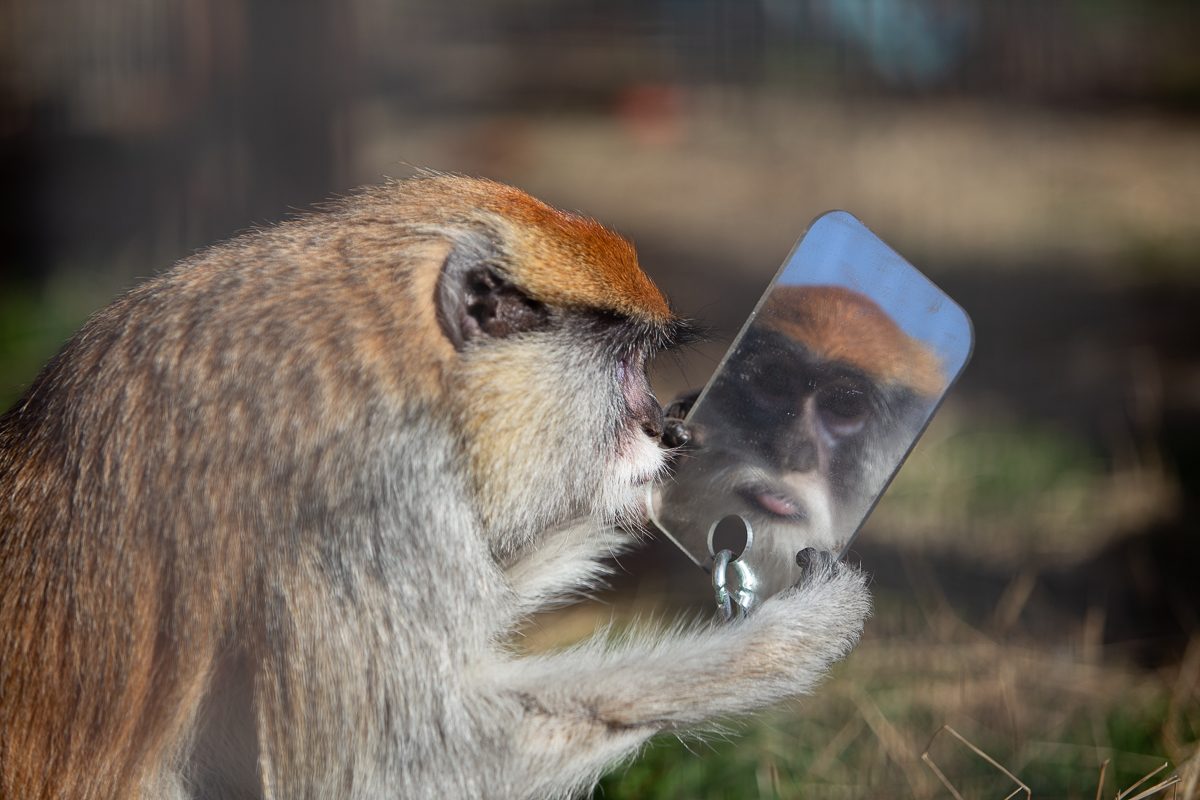
The mirror self-recognition test asks whether an animal can use a reflection as information about its own body. In the classic mark test, researchers place a visible mark on a body area the subject cannot inspect directly, then watch what happens after mirror exposure. Touching, rubbing, or examining that mark while looking at the reflection counts as self-directed behavior. Gordon Gallup introduced the modern chimpanzee study in 1970, giving the method its best-known form.
A good result requires more than an animal looking at a mirror. Researchers usually track a sequence: social reactions toward the image, exploratory movements that test the image's matching actions, and later self-directed inspection. A chimpanzee may use the glass to inspect its teeth; an elephant may position its body so its trunk can reach a marked area. These actions show that the reflection is being treated as a model of the animal's body, not simply as a rival.
The test is narrow. It examines visual self-recognition under an unusual laboratory arrangement, not a complete measure of intelligence or consciousness. A 2006 study of Asian elephants tested three animals and reported one clear mark-test success, while the other two still showed mirror-related behaviors worth studying. That small sample illustrates why species labels should not be read as a scorecard.
Why The Result Is Hard To Read
A failed mark test has several possible explanations. The mark may be hard to see, placed where the animal cannot reach it, or too uninteresting to trigger grooming. A species that relies on smell, touch, sound, or body movement may not treat vision as its main route to self-information. Dogs, for example, can be assessed with scent-based designs more naturally than with a colored spot on the forehead.
Mirror experience also changes behavior. An animal seeing a mirror for the first time may react defensively, ignore it, or need days of exposure before testing the image. Age, health, social setting, captivity, and individual temperament affect participation. In an eight-year chimpanzee follow-up, many animals retained their earlier classification, but some older subjects no longer met the same criterion. That finding cautions against treating a single session as a permanent trait.
Researchers must separate a genuine mark response from clever use of visual geometry. An animal might see a colored patch in the reflection and reach toward the corresponding spot without forming a human-like concept of self. Sham marks, no-mirror controls, repeated trials, and video coding reduce that risk. They do not remove every interpretive problem, because behavior never arrives with a label explaining the animal's private experience.
How Researchers Test
Start With Safe Acclimation
Researchers first introduce a large, stable mirror without a mark. They record whether the animal approaches, retreats, threatens the image, vocalizes, or begins inspecting its own body. This phase can last several days or longer, depending on the species. A mirror must be placed where the subject can move freely and cannot injure itself or shatter the surface. Familiar keepers, ordinary feeding times, and quiet observation reduce stress that could mask natural behavior.
Early social behavior is not a pass or fail. A territorial display can show that the image is initially treated as another animal, while repeated contingency testing may show that the subject notices the image follows its movements. In practical terms, researchers look for head turns, unusual poses, mouth movements, and viewing angles that would make little sense during a normal encounter with a rival. The behavior is coded rather than interpreted from one memorable clip.
Use A Hidden Mark And Control
After acclimation, a harmless mark is placed while the animal cannot watch, often during routine handling or sedation approved by an ethics committee. The mark sits on a body region hidden from direct view and is matched with an invisible sham mark on another trial. Researchers then compare mark-directed actions during mirror access with actions when no mirror is present. A response counts as stronger evidence when it is repeated, directed at the marked site, and coordinated with mirror viewing.
Controls matter because animals may groom more after handling, react to a smell from the marker, or notice a researcher touching the skin. A color that contrasts with an elephant's skin may be easy to detect, while a small mark on a dark feather may not be. The famous 2008 magpie study used colored marks and reported self-directed behavior in some birds, but later debate over replication shows why sample size, mark visibility, and independent coding deserve close attention.
Compare Behavior Across Trials
A sound protocol includes baseline observations, mirror-only sessions, mark trials, sham trials, and no-mirror trials. The order should be planned so that learning or fatigue does not create a false pattern. Researchers can record latency, number of mark-directed touches, viewing duration, and the body parts used. For a fish, scraping a throat against a surface after viewing a mark may be more natural than touching it with a limb.
Cleaner wrasse studies illustrate this adaptation. The fish normally remove visible parasites from client fish, so investigators placed marks in a location the fish could not see directly and observed scraping behavior after mirror exposure. A 2019 report described mark-directed scraping, yet the result remains debated because the behavior could reflect learned visual-to-body mapping without human-like self-awareness. Repeated, species-appropriate tests are more informative than a dramatic headline.
Interpret The Whole Pattern
The strongest interpretation combines several observations. The animal first explores the mirror, tests the relation between movement and image, uses the reflection to inspect an otherwise hidden body part, and does so more often with a real mark than a sham mark. A single touch is weak evidence; a coherent sequence across controls is stronger.
Researchers should report individual results instead of turning a handful of subjects into a claim about every member of a species. The bottlenose dolphin evidence came from controlled work with individual animals, and elephant research also involved very small samples. That does not make the studies useless. It tells readers to distinguish “some tested individuals showed the behavior” from “the species has a uniform mental capacity.”
Case Examples From Studies
Asian elephants produced a notable result in a 2006 study. Subjects used a large mirror to inspect themselves, and one touched a visible mark on its head while facing the reflection. Trunk reach, body size, and mirror placement shaped the experiment. A small number of animals and mixed individual responses mean the finding is best described as evidence of mirror self-recognition in at least one tested elephant, with supporting behaviors in others.
European magpies expanded the debate beyond mammals. The 2008 study reported mark-directed behavior after mirror exposure, suggesting that a neocortex is not a prerequisite for the task. Corvid brains differ greatly from mammalian brains, so the result cautions against treating one brain structure as a simple requirement for a cognitive behavior. Replication questions remain part of the story and should accompany any confident species list.
Cleaner wrasse are the most controversial entry. In 2019, researchers reported that marked fish scraped the mark after observing themselves in a mirror. The result may indicate a form of visual self-recognition, or it may show a sophisticated learned association that does not carry the same meaning as human self-awareness. The fair conclusion is that the fish produced behavior that challenges simple assumptions about brain size, while the mental interpretation stays open.
Imagine an adult chimpanzee that has lived around mirrors for weeks. During a baseline session it uses the glass to inspect its mouth, then, after a concealed mark is added to its brow, it repeatedly touches the spot while watching the reflection. It does not show the same behavior with an invisible sham mark. The pattern supports mirror-guided self-inspection, but it does not reveal whether the chimpanzee thinks in words or holds a human-style narrative identity.
Evidence At A Glance
| Animal group | Reported behavior | Research date | How to read it |
|---|---|---|---|
| Great apes | Self-inspection and mark touching | 1970 onward | Strongest and longest record |
| Bottlenose dolphins | Mirror-guided body examination | 2001 | Adapted for aquatic anatomy |
| Asian elephants | Trunk contact with visible mark | 2006 | Small sample, mixed responses |
| European magpies | Mark-directed movements | 2008 | Positive report with replication debate |
| Cleaner wrasse | Scraping after mirror viewing | 2019 | Intriguing, disputed interpretation |
Use this table as a reading guide, not a ranking. “Positive” describes a behavioral pattern under a particular protocol. It does not say that an elephant is more conscious than a dog, or that a magpie has the same kind of self-concept as a person. A checklist for assessing a new claim is simple: identify the species and individuals, find the original study, inspect the control conditions, check the mark's visibility and location, and read the authors' limits before accepting a headline.
Common Mistakes To Avoid
The first mistake is equating mirror failure with a lack of self-awareness. A cat may recognize its own scent, a dog may distinguish its body odor from another dog's, and a bat may use sound in ways a visual test cannot capture. Failure means that the animal did not meet this visual criterion under these conditions. It does not establish that no self-related processing exists.
The second mistake is treating mirror interest as recognition. Staring, posing, or attacking the image may show curiosity, social confusion, or a response to novelty. Without a concealed mark and suitable controls, those actions cannot carry the same evidential weight as targeted self-inspection.
The third mistake is ignoring anatomy. A dolphin cannot scratch its back, a fish has no hands, and a bird may remove a mark with a foot or by rubbing. A fair protocol asks what self-directed action the animal can physically perform. Researchers also need marks that are visible, odor-neutral, harmless, and unlikely to change ordinary grooming.
The fourth mistake is reading a small study as a census. Three elephants, two dolphins, or a limited group of magpies cannot represent every individual, age, sex, or social history. Look for replication, transparent coding, and results from both successful and unsuccessful subjects.
FAQ
Which animals have passed the mirror test?
Strong reported evidence exists for some great apes, bottlenose dolphins, Asian elephants, and European magpies; cleaner wrasse have produced a disputed but influential result.
Does passing prove self-awareness?
It supports visual self-recognition, but it cannot measure every form of consciousness, private thought, or a human-like sense of identity.
Why do most animals fail?
The task favors animals that see well, care about a visible body mark, have a way to reach it, and understand mirrors as body information.
Can dogs recognize themselves?
Dogs have not shown convincing performance on the standard visual mark test, yet scent-based research may be better suited to their sensory priorities.
What makes a study credible?
Look for acclimation, sham and no-mirror controls, a hidden mark, repeated trials, individual results, transparent coding, and clear limits on the conclusion.
Author's Insight
The mirror test is most useful when treated as a carefully bounded behavioral tool. Its history shows that cognition can evolve in animals with very different bodies and brains, from apes to corvids and reef fish. The cleaner wrasse debate also shows why a positive action does not automatically reveal the quality of an animal's inner experience. Readers gain a better picture by asking what the protocol measures, what it leaves out, and how well the behavior repeats.
Key Takeaways
Mirror self-recognition has been reported in a short list of animals, with the clearest record in great apes and clear evidence in dolphins, Asian elephants, and magpies. Cleaner wrasse have widened the discussion, though their result remains contested. The mark test measures one visual route to body recognition; it does not grade an animal's overall mind. Read the controls, sample size, anatomy, and sensory ecology before drawing a conclusion, and treat a failed test as a limit of the method rather than a verdict on the animal.