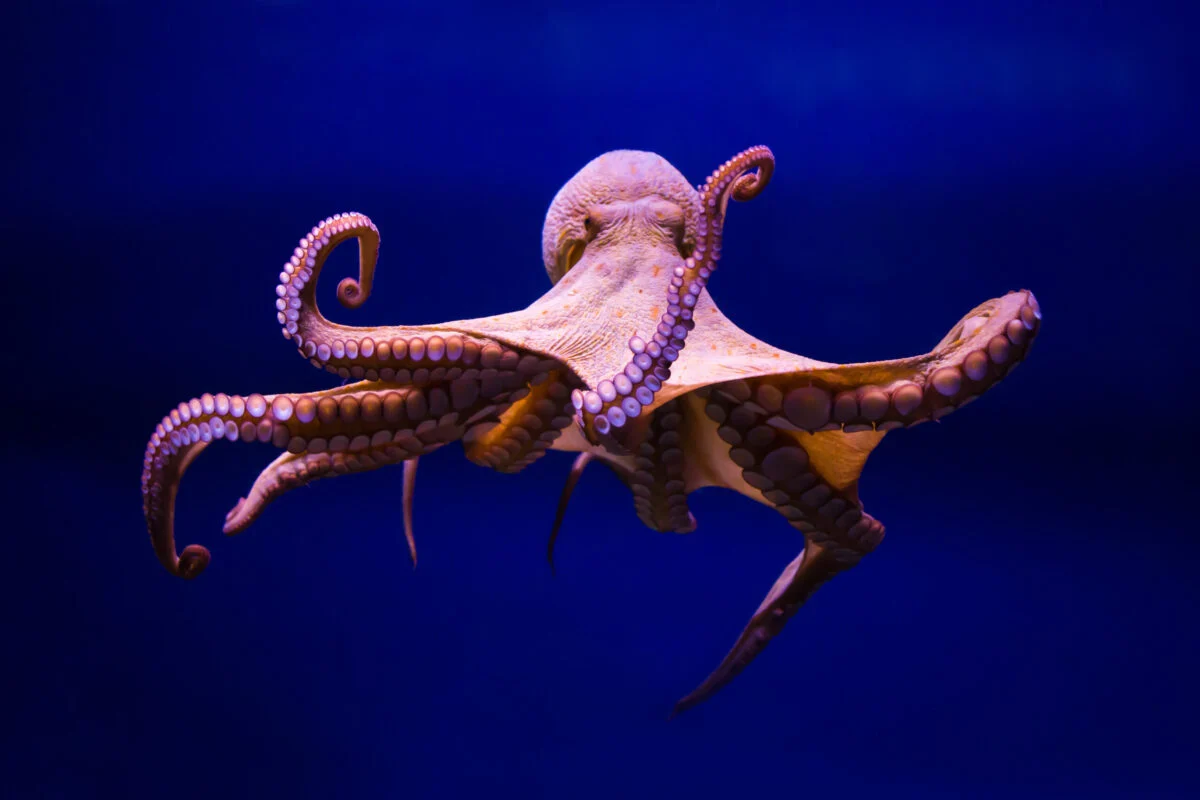
Octopus Hearts In Plain Terms
An octopus has three hearts: two branchial (gill) hearts and one systemic heart. The gill hearts pump blood through the gills, where oxygen exchange happens, and the systemic heart sends oxygenated blood to the rest of the body. This arrangement matches the octopus’s respiratory setup: water flows over gills, and blood must be routed efficiently to those exchange surfaces.
Researchers have measured that octopuses use hemocyanin, an oxygen-carrying protein that contains copper. Hemocyanin’s oxygen binding changes with oxygen concentration, which helps explain why oxygen delivery depends on both water flow and blood routing. In many cephalopods, blood is also relatively “thick” in behavior compared with mammals, and that affects how pumping pressure translates into flow.
Three hearts, one job.
How The Three Hearts Work
The gill hearts pump blood through gills, where oxygen diffuses from water into blood. The systemic heart then pumps oxygenated blood into the body’s circulation. This separation reduces the need to push all blood directly through exchange surfaces using one pump, which can be inefficient when the exchange surfaces are localized.
Hemocyanin’s oxygen binding is sensitive to oxygen levels, which means the blood’s oxygen content depends on local conditions at the gills. That creates a feedback-like relationship: if gill oxygen loading drops, the systemic circulation carries less oxygen even if pumping continues.
Coordination matters more than speed.
Octopus circulation also involves pressure gradients and vessel resistance. If gill resistance rises, the gill hearts must generate enough pressure to maintain flow. If they cannot, oxygen loading decreases, and tissues experience reduced oxygen delivery.
Researchers also describe that cephalopod hearts show rhythmic activity and that neural and muscular control influences pumping. The exact control pathways vary by species, and published details differ across studies, so readers should treat “one universal mechanism” claims cautiously.
Solutions And Tips
Use Behavior To Predict Oxygen
When observing octopuses in aquaria or educational settings, track ventilation behavior rather than only heartbeats. Ventilation changes water flow across gills, which directly affects oxygen loading. In practice, you can note mantle movements and water jetting patterns, then relate those to likely oxygen uptake changes.
Ventilation often limits oxygen.
Why this works: gill hearts can only pump blood to the gills, and oxygen exchange depends on oxygen availability in the water at the gill surface. If water flow slows, the limiting factor becomes oxygen transfer across the gill boundary layer, not systemic pumping.
What it looks like: increased mantle pumping usually corresponds to stronger water movement across gills, while reduced ventilation often corresponds to lower oxygen uptake. A side observation from many marine biology demonstrations is that animals may “pause” ventilation during certain resting postures, which can confuse viewers who expect constant activity.
Focus On Hemocyanin Constraints
When reading about cephalopod oxygen transport, look for hemocyanin-related details such as oxygen affinity and how it changes with oxygen concentration. Hemocyanin differs from mammalian hemoglobin, so oxygen content vs. oxygen partial pressure relationships do not match mammal intuition. In practice, compare how studies describe oxygen binding curves rather than relying on simplified “more oxygen in means more oxygen out” statements.
Oxygen binding is not linear.
Why this works: if hemocyanin’s binding behavior shifts with oxygen levels, then the same pumping pattern can yield different oxygen loading depending on water oxygen concentration. That helps explain why heart count alone does not predict oxygen delivery.
What it looks like: a paper may report oxygen partial pressure ranges and show how saturation changes across that range. If you see only a single number without context, treat it as incomplete.
Interpret Heart Studies Carefully
When evaluating research claims about “three hearts,” check what was measured: heart rate, stroke volume, blood flow, or oxygen consumption. Different endpoints answer different questions, and a study that reports heart rate alone may not show oxygen delivery. In practice, read the methods section for whether researchers used imaging, pressure sensors, or respirometry.
Heart rate ≠ oxygen delivery.
Why this works: oxygen delivery depends on both pumping and exchange at the gills, plus blood chemistry. A heart can beat faster while oxygen uptake stays limited by water flow or gill exchange efficiency.
What it looks like: a study might combine respirometry (measuring oxygen consumption in mg O2 per hour) with cardiovascular measurements. If you see only one measurement type, interpret conclusions as partial.
Use Simple Oxygen Budgeting
For educational explanations, build a basic oxygen budget: oxygen uptake at gills plus oxygen transport to tissues minus oxygen use by tissues. Even without exact species-specific numbers, you can show how changes in ventilation or water oxygen concentration shift the budget. In practice, ask learners to identify the likely limiting step: water oxygen availability, gill exchange, or circulation.
Identify the limiting step.
Why this works: physiology often behaves like a series system, where the slowest step limits overall throughput. The three-heart design changes the circulation stage, but it does not remove limits at the gills.
What it looks like: if water oxygen drops, oxygen uptake drops even if hearts remain active. If ventilation drops, oxygen uptake drops even if water oxygen stays constant.
Apply Animal Welfare Logic
In aquaria or research tanks, oxygenation and water flow matter for cephalopods, and heart physiology responds to those conditions. Use measured dissolved oxygen and stable temperature rather than guessing from behavior alone. In practice, many facilities target dissolved oxygen levels using calibrated probes, and they monitor trends during feeding and handling.
Dissolved oxygen is measurable.
Why this works: oxygen exchange at gills depends on dissolved oxygen concentration and water movement. If dissolved oxygen falls, hemocyanin saturation at the gills decreases, and systemic delivery follows.
What it looks like: a log might show dissolved oxygen in mg/L and temperature in °C, with corresponding changes in ventilation. A mild frustration in hobbyist settings is that “looks fine” observations can miss slow oxygen declines that only show up in probe data.
Case Examples
Lab Demo With Ventilation Shifts
An educator observes an octopus during a feeding session in a controlled tank. The animal increases mantle contractions for several minutes, then settles into a lower-ventilation posture. The educator records ventilation frequency and notes that the animal’s activity level changes, while dissolved oxygen in the tank remains stable at a measured setpoint.
The lesson: the three-heart system does not override the gill exchange step. Even with stable dissolved oxygen, ventilation changes water flow across gills, which changes oxygen uptake and can influence how quickly the animal returns to baseline behavior.
Student Misread Of Heart Rate
A student reads a summary stating that “octopuses have three hearts” and concludes that the systemic heart alone determines oxygen supply. In a follow-up assignment, the student compares a respirometry study that reports oxygen consumption rates with a cardiovascular measurement study that reports heart rhythm changes. The student finds that heart rate changes do not always track oxygen consumption, which indicates that gill exchange and ventilation can be limiting.
The lesson: heart count and heart rate describe part of the system. Oxygen delivery depends on coordinated gill pumping, water flow, hemocyanin oxygen loading, and tissue demand.
Comparison Table
| Question To Ask | If You Focus On Hearts | If You Focus On Gills | If You Focus On Oxygen Use |
|---|---|---|---|
| What limits oxygen delivery? | Pumping capacity and routing | Water flow and dissolved oxygen | Tissue demand during activity |
| Common misread | Heart rate predicts oxygen uptake | Ventilation changes are ignored | Oxygen consumption is treated as constant |
| Best supporting measurement | Blood flow or pressure data | Dissolved oxygen and flow rate | Respirometry oxygen consumption |
| Typical outcome | Routing changes oxygen distribution | Exchange changes oxygen loading | Demand changes oxygen drawdown |
Common Mistakes
One mistake is treating the three-heart system as a single “superpower” that guarantees high oxygen delivery under any condition. Oxygen delivery still depends on gill exchange, dissolved oxygen, and ventilation patterns, so the system can fail to meet demand when water oxygen or flow drops.
Another mistake is using mammal analogies too literally. Mammals rely on lungs and one main pump, while octopuses rely on gills and a split pumping arrangement. The analogy can help with intuition but it breaks down when you compare oxygen-binding proteins and circulation routing.
Overgeneralization causes errors.
A third mistake is repeating simplified diagrams without checking whether they match the species or the study conditions. Some descriptions omit details like how blood returns to the systemic circuit, and those omissions matter when you interpret measurements.
FAQ
Do All Octopuses Have Three Hearts?
Most octopus species described in standard marine biology references have two gill hearts and one systemic heart, but anatomy and measurements can vary by species and study. If a source names a specific species, use that context rather than assuming identical proportions across all octopuses.
What Do The Two Gill Hearts Do?
The two gill hearts pump blood through the gills for oxygen exchange. They influence how much oxygen the blood can load from water, so they affect oxygen delivery even when the systemic heart rate stays unchanged.
Why Does The Systemic Heart Matter?
The systemic heart pumps oxygenated blood from the gills to body tissues. It determines distribution once oxygen loading has occurred, so it cannot compensate for low oxygen exchange at the gills.
How Does Ventilation Affect Oxygen Delivery?
Ventilation changes water flow across the gills, which changes oxygen transfer into blood. Even with active heart pumping, reduced water flow can limit oxygen loading, and oxygen consumption can rise during activity.
What Blood Chemistry Is Involved?
Octopuses use hemocyanin, an oxygen-carrying copper-containing protein. Hemocyanin’s oxygen binding behavior depends on oxygen concentration, so oxygen content in blood depends on gill conditions, not only on circulation speed.
Author's Insight
The three-heart design makes sense when you treat oxygen delivery as a chain: water flow to gills, oxygen loading into blood, then distribution to tissues. The gill hearts and systemic heart split the workload so that oxygen exchange and circulation can be coordinated. Many misunderstandings come from focusing on heart count while ignoring ventilation and gill exchange limits, which often set the real boundary conditions. A careful read of methods—especially whether studies measure oxygen consumption and not just heart rhythm—usually clarifies what the data can and cannot claim.
Key Takeaways
- Two gill hearts pump blood through gills for oxygen exchange; the systemic heart distributes oxygenated blood to tissues.
- Oxygen delivery depends on coordinated pumping plus ventilation-driven water flow and dissolved oxygen at the gills.
- Heart rate alone does not predict oxygen consumption; respirometry and flow/oxygen measurements give a fuller picture.
- Species differences and study conditions affect anatomy and physiology, so match claims to the named species and measured endpoints.
- When evaluating explanations, check whether the source addresses gill exchange limits, not only the number of hearts.