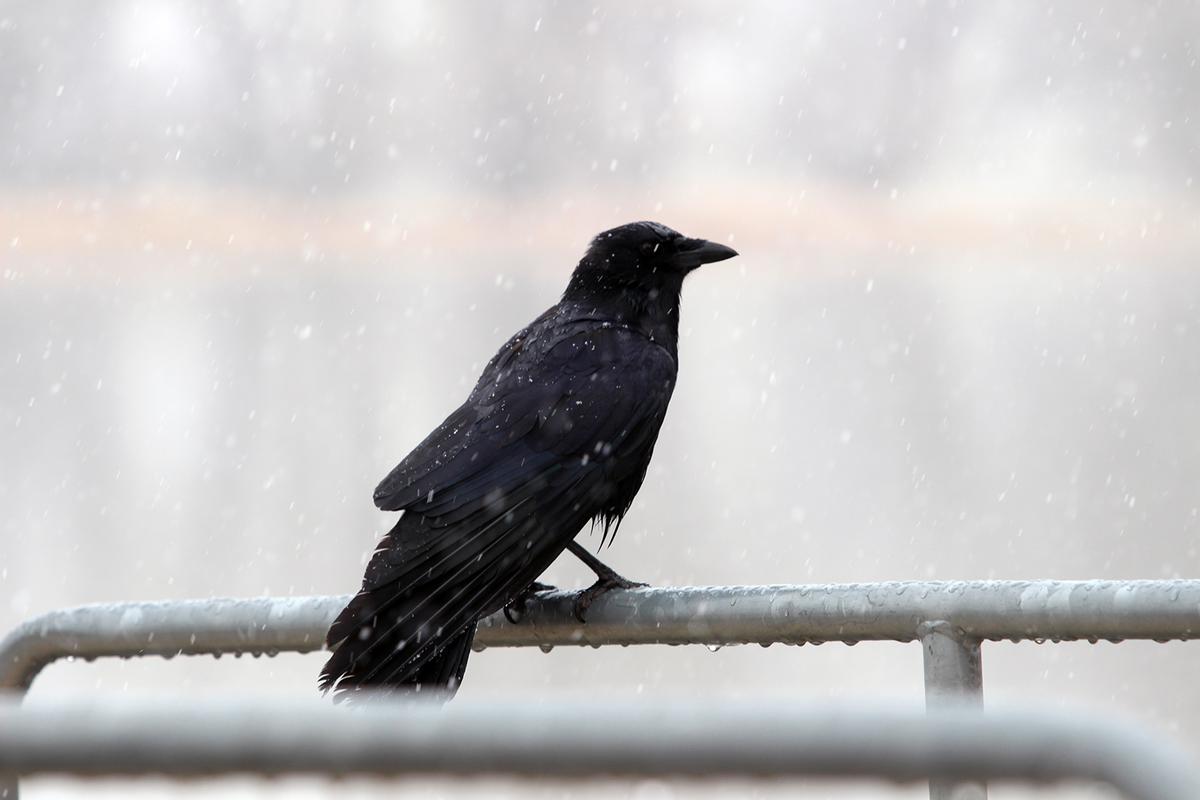
How Crow Memory Works
American crows can learn to distinguish individual human faces and attach a consequence to the person they see. In a field experiment published in 2010, researchers wore a distinctive mask while trapping, banding, and releasing wild crows at five sites near Seattle. The birds later scolded and mobbed that mask far more than neutral masks. The learned response remained detectable for at least 2.7 years, despite the original encounter lasting only a short time.
This is recognition joined to association, not a claim that a crow studies a face exactly as a person does. The bird sees a pattern of features, connects it with an event, and retrieves that link when a similar pattern appears. A 2012 brain-imaging study found different forebrain activity when captive crows viewed faces linked with danger, care, or no prior meaning. The result supports a memory system shaped by experience rather than a simple reflex to any person.
Face recognition helps a crow make a fast risk decision in a busy habitat. A person carrying a net deserves a different response from a person who leaves food, while a stranger may call for caution until the flock has more information. The face is one cue among several: posture, movement, voice, clothing, location, and the bird's recent history can alter the final reaction.
Why Recognition Gets Tricky
A crow's response does not prove that it has identified a face in isolation. Researchers must separate facial cues from hair, gait, clothing, mask shape, and the place where an encounter happened. A person who changes a coat but keeps the same face may still trigger a reaction, yet a low view from a rooftop can make a familiar face hard to see.
Context also changes the meaning of alarm. A crow near a nest is more vigilant than one feeding in an open field. Several birds calling together can make a passerby think a whole neighborhood remembers a single event, even though some birds may be reacting to their companions rather than to the person.
Memory is not a permanent photograph. Recognition can weaken, compete with newer associations, or shift as a bird matures. The 2.7-year result is a measured lower boundary from one study design, not a guarantee that every crow remembers every face for that span. Nor does it show that a crow can identify a person under every disguise, distance, light level, or angle.
Ways To Study Crow Faces
Use Matched Face Cues
A sound experiment changes one cue at a time. Researchers can keep a mask, route, posture, and exposure duration consistent while comparing a dangerous face with a neutral face. In the Seattle study, the distinctive mask made the encounter repeatable, so later mobbing was easier to link with the learned visual cue. A matched design matters because a bright jacket or unusual walk could otherwise explain the result.
For an observation at home, note the face, clothing, distance, weather, location, and number of birds before drawing a conclusion. A short log in a phone note can reveal that birds react to a feeding routine or nesting boundary rather than to facial appearance alone.
Measure More Than Noise
Alarm calls are useful but incomplete. A study can record how many birds approach, how long they remain nearby, how often they call, and how quickly they return to normal behavior. Repeated tests with neutral people help establish a baseline. One dramatic swoop is a story; a consistent difference across trials is stronger evidence.
Researchers also need a control for exposure. If a crow sees a person ten times while nothing happens, it may habituate. If a person handles a bird once, the association may be unusually strong. Recording both exposure count and delay before testing keeps memory claims tied to measurable events.
Separate Face From Context
Researchers can test the same face at different sites or show a face from a new angle. A response that travels with the face is stronger evidence for face-based recognition than a response that stays at one tree. Captive tests with photographs can examine visual discrimination, while field tests show how recognition operates amid wind, flock calls, and competing risks.
The 2012 imaging work added another layer by comparing brain activity after crows viewed faces with different histories. Such scans do not read a bird's thoughts. They show that learned meaning changes neural activity, which fits the behavioral evidence without turning it into a human-style autobiography.
Respect The Birds
Observation should not create the very stress it claims to measure. Keep a generous distance from nests, do not chase or bait birds into traffic, and avoid repeating a frightening act. Binoculars and a quiet fixed position are enough for most backyard notes. A camera can record timing, but it should not become a flash or a moving lure.
Ethical fieldwork uses the smallest disturbance that can answer the question. If a crow changes its route, stops feeding, or keeps alarm calling, end the observation. The clearest natural-history record is one in which the birds can resume ordinary behavior.
Two Everyday Case Examples
Imagine a resident who walks the same park path each morning. During nesting season, two crows call whenever the resident passes a particular oak, but they ignore the same person on a wider path in autumn. The pattern suggests a place and season effect. It does not, by itself, show that the birds have stored a detailed portrait of that resident.
Now imagine a wildlife worker who once used a net while wearing a distinctive hat and face covering. Weeks later, crows react to the covering even when the worker carries no net. If neutral coverings and other people do not trigger the same response, the case fits a learned association. The worker should change the route and stop testing the birds rather than trying to win their trust through repeated exposure.
Evidence At A Glance
| Evidence Type | What It Tests | What It Shows | Main Limit |
|---|---|---|---|
| Field exposure | Later response to a known cue | Long-lasting learned association | Other cues may travel with the face |
| Photograph task | Visual discrimination under control | Ability to sort face patterns | A still image lacks natural context |
| Brain imaging | Neural response to learned meaning | Experience changes forebrain activity | Activity is not a spoken explanation |
Use the rows as a reading checklist. Stronger claims combine controlled cues, repeated observations, and a clear comparison group. A headline saying that crows “never forget” goes beyond the measured results; a report that names the species, date, exposure, delay, and response gives readers enough context to judge the claim.
Common Observation Mistakes
The first mistake is treating every crow as part of one shared mind. A flock is a social network, yet individual birds differ in age, experience, rank, and exposure. A second mistake is assuming that mobbing means hatred. Alarm behavior may reduce perceived danger, recruit neighbors, or drive a predator away; human emotion is not needed to explain it.
A third mistake is repeating a frightening encounter to see if memory lasts. That turns a harmless observation into a stress test and can change the birds' behavior. A fourth is counting only the loudest event and ignoring quiet avoidance. Leaving a feeding area, taking a longer route, or watching from a roof can also signal altered risk assessment.
A final mistake is repeating the popular claim that crows possess a fixed number of years of face memory. The field result establishes persistence in the tested group and conditions. It does not set a universal expiration date or prove that the same ability works equally well for every crow, face, and setting.
FAQ
Do crows really recognize human faces?
Yes. Controlled field and captive studies indicate that crows can distinguish human faces or face-linked visual cues and associate them with past outcomes.
How long can a crow remember a face?
Wild American crows in one 2010 experiment retained a learned response to a threatening mask for at least 2.7 years.
Can crows recognize a kind person?
They can learn associations with people who feed or handle them calmly, but a friendly response may also depend on routine, food, voice, and location.
Do crows tell other crows about a person?
Alarm behavior can spread information through a social group, yet each bird's own experience and the strength of the evidence must be separated.
Can changing clothes fool a crow?
Clothing can change the visual scene, but it is not a reliable disguise because the bird may use facial features, movement, place, and prior associations together.
Author's Insight
The strongest lesson is that crow memory has a practical job: it helps a social bird classify risk in a changing neighborhood. Recognition appears to be built from visual pattern learning plus the emotional and social consequences of an encounter. The studies also show why a memorable headline needs a careful boundary; a crow may recognize a cue without possessing a human-style portrait or story. Readers can appreciate the ability more accurately by asking what was exposed, what was measured, how long the delay lasted, and which alternative cues were controlled.
Key Takeaways
Crows can remember a human face-linked cue for years, especially when an encounter carries a strong consequence. Their behavior reflects associative learning, individual experience, and social information, not a magical archive of every passerby. For observation, record repeated patterns, compare neutral situations, protect nesting birds, and avoid provoking a test. The research supports impressive long-term recognition while leaving open questions about how crows combine faces with voices, clothing, movement, and place.