Lightning Begins In A Storm
A lightning bolt is not a single spark switching on from cloud to ground. It is a sequence of electrical breakdowns that creates a temporary conducting channel through air. In a tall thunderstorm, collisions among ice crystals, supercooled droplets, and graupel separate charge. A broad negative region often forms in the middle or lower cloud, while positive charge gathers higher up and near the ground beneath it. The exact initiation process remains an active research subject, yet the visible flash has a well-studied outline.
For a cloud-to-ground stroke, the first hidden motion usually comes from the cloud. A stepped leader advances in jumps of roughly 50 to 100 meters, with individual steps lasting about one microsecond. The channel branches as it seeks a route through air whose insulating strength is being overcome. The event may span several kilometers, but the eye mostly sees the later, brighter discharge.
Once a connection forms, the return stroke races up the channel at roughly 100 million meters per second in measured examples. Its luminous phase lasts tens of microseconds, and channel temperatures can reach about 30,000 kelvins. That flash heats nearby air so quickly that a pressure wave forms; we hear that wave as thunder.
The Hidden Path Downward
The stepped leader is a faint, negatively charged plasma channel descending from a charge center. It does not glide smoothly like a wire being lowered. Each jump creates a short ionized segment, pauses, and then branches again. Electric fields at the tips intensify the next breakdown, so the leader can explore several paths at once.
Near the surface, the approaching leader changes the electric field around trees, roofs, poles, and people. Upward-moving positive streamers can rise from those objects. They are not all equally tall, and the eventual connection is shaped by local field strength, object height, terrain, and channel geometry. The first streamer to join the descending path closes the gap.
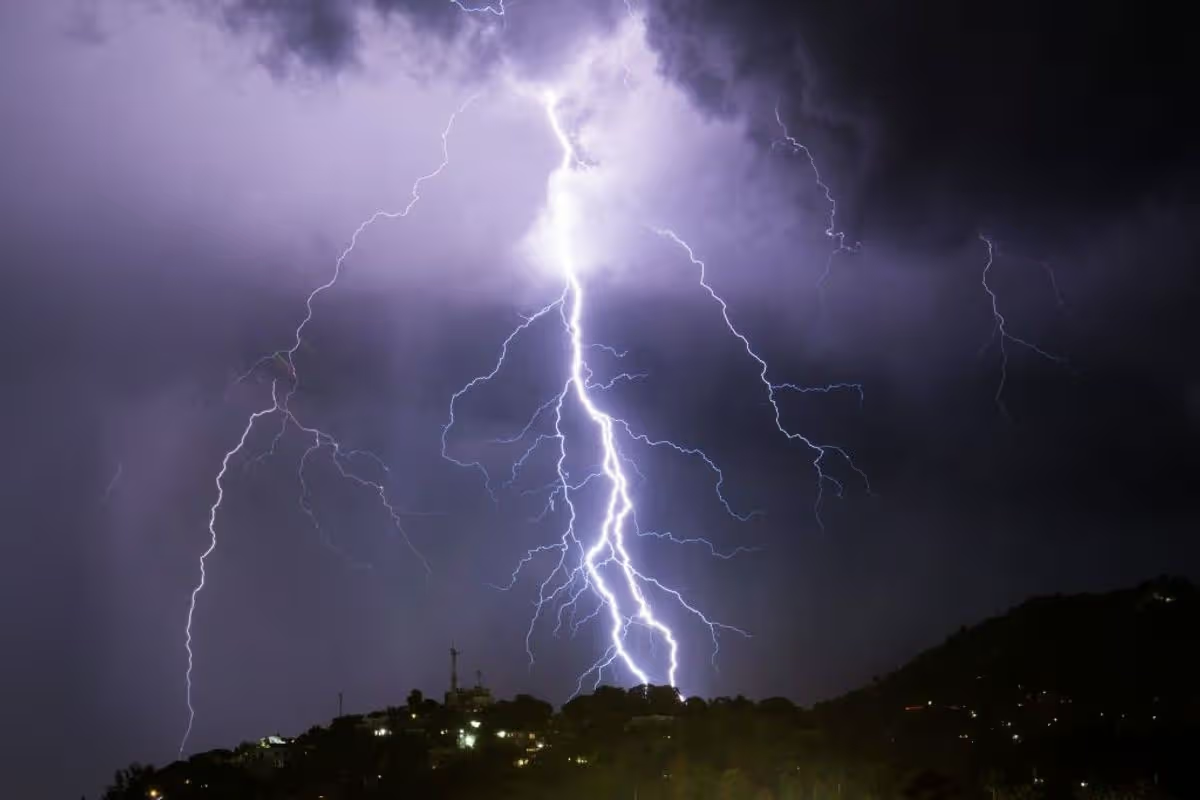
This explains why a strike point cannot be predicted from the tallest object alone. A nearby tree may be struck, yet a lower object can also connect under the right field pattern. The branching seen in photographs records the leader's exploratory history, not a map of safe and unsafe places.
What To Do Near A Strike
Read The First Flash
Treat any visible flash or thunder as evidence that the storm is close enough to threaten you. The delay between light and sound estimates distance: count seconds from flash to thunder, then divide by five for an approximate distance in miles, or by three for kilometers. A 15-second delay is about 3 miles, or 5 kilometers. The estimate is rough because wind, terrain, and storm structure bend and scatter sound.
Move into a substantial enclosed building or a hard-topped vehicle as soon as thunder begins. A picnic shelter, tent, porch, open garage, or convertible roof does not form the same enclosure. Outdoor activity should resume only after the local storm has passed; a common safety rule is to wait at least 30 minutes after the last thunder.
Choose A Safer Place
Inside a building, stay away from windows, doors, plumbing, concrete floors, and wired electronic equipment during the storm. The goal is to reduce contact with conductive paths and keep away from openings where a side flash or flying debris could reach you. Unplugging equipment during active lightning is unsafe if it requires touching a cord or outlet; disconnect sensitive devices before the storm arrives.
If no building or vehicle is reachable, leave exposed ridges, isolated trees, water, fences, and metal structures. Spread people apart rather than clustering, which reduces the chance that one injury affects everyone. There is no reliable crouch position that makes open ground safe; keep moving toward shelter without lying down.
Understand The Channel
The bright channel is hot, conductive, and short-lived, but its disappearance does not mark an immediate return to safety. A flash can contain several strokes along the same or a nearby path. The first return stroke may be followed by a dart leader that travels down the already prepared channel, then another return stroke travels upward. Lightning location systems count strokes, not just the visual blink.
Use that sequence to interpret flickering lightning: repeated brightness is not a harmless afterglow. A typical flash may contain two or three return strokes, while observed flashes can range from one to many more. Stay sheltered during the whole storm rather than timing a dash between strokes.
Protect People Afterward
Someone struck by lightning does not retain an electrical charge, so touching the person is safe. Call emergency services, begin first aid, and use an automated external defibrillator when available. Lightning injuries can stop breathing or the heart, and a person who appears unconscious may still be resuscitated. Check the scene for ongoing storm danger before approaching, then assess breathing and responsiveness.
Medical assessment is needed even when burns look small. Current can affect the nervous system, hearing, vision, heart rhythm, and muscles. If several people are injured, attend first to those who appear lifeless but may be revived, while asking bystanders to contact responders and retrieve an AED.
Two Split Second Scenarios
Imagine a family watching a storm from a covered campsite. They see a flash and hear thunder 12 seconds later, about 2 miles away. The shelter keeps rain off, but its open sides do not turn it into a safe building. Moving to a nearby enclosed car before the next flash reduces exposure; waiting there until 30 minutes after the last thunder addresses the storm's continuing reach.
In another scenario, a school field has one visible lightning channel followed by two quick flickers. A student assumes the first bolt has spent its charge. The flashes are better understood as multiple strokes within one flash, with new leader activity using an existing channel. Staff move the group indoors, separate wet clothing from electrical equipment, and check anyone reporting chest pain, confusion, weakness, or hearing loss.
Flash Stages At A Glance
| Stage | What moves | What you notice | Useful response |
|---|---|---|---|
| Charge separation | Ions and charged ice within the cloud | Dark cloud, rising wind, static hair | Plan shelter early |
| Stepped leader | A branching channel descends | Usually too faint to see | Do not wait for a strike |
| Connection | An upward streamer meets the leader | A bright flash follows | Remain under cover |
| Return stroke | High current travels upward | Light, heat, thunder | Assume danger continues |
Common Lightning Mistakes
A frequent error is treating the first flash as the beginning and end of the event. The visible return stroke is late in the sequence, and later strokes may follow along the channel. Another error is confusing the speed of light with the speed of the discharge: the flash reaches your eyes almost instantly, but the return stroke itself travels through a physical channel at a lower, measured speed.
People also mistake a roof without walls for indoor shelter. Open pavilions block rain but leave occupants exposed to ground current, side flashes, and nearby strikes. Cars work because their metal shell can carry current around the occupants; rubber tires are not the main protective feature.
A third error is using a weather app's absence of a nearby alert as a personal guarantee. Detection networks have location and timing limits, and a storm can move between updates. Use thunder, official warnings, radar, and the available shelter around you together. Do not stand beneath an isolated tree, hold a metal umbrella on an exposed field, or return outside because the rain has stopped.
FAQ
Does lightning travel from cloud to ground?
The initiating stepped leader commonly travels downward, but the bright return stroke travels upward from the connection point toward the cloud. A flash is a sequence, not one-direction motion.
How hot is a lightning channel?
Measurements and atmospheric references place the channel near 30,000 kelvins during the return stroke, hot enough to expand surrounding air and create thunder.
Why does lightning flicker?
One flash can contain repeated strokes. Dart leaders reuse an ionized path, and each new return stroke briefly brightens it again.
Can a person be touched after a strike?
Yes. A lightning victim does not store an electrical charge, so call emergency services, start first aid, and use an AED if one is available.
How long should I wait outside?
Wait at least 30 minutes after the last thunder before resuming outdoor activity, and seek shelter again if thunder returns.
Author's Insight
The most useful mental model is a branching search followed by a bright discharge, followed by possible repeats. It explains why the first visible flash arrives after hidden leader activity and why a single photograph can show many branches. The measured time scales are tiny, but the safety decision is simple: thunder means the storm is close enough to change your plans. Understanding the sequence improves judgment without turning a dramatic natural event into a predictable target map.
Key Takeaways
Inside a cloud-to-ground bolt, separated charge drives a stepped leader downward, an upward streamer completes the path, and a return stroke sends intense current upward through the ionized channel. Rapid heating creates thunder, while later strokes can create flicker. The exact attachment point remains difficult to predict, so distance estimates and visual guesses cannot replace shelter. Move into a substantial building or hard-topped vehicle when thunder starts, stay there through the storm, and wait 30 minutes after the last thunder before going back outside.