Ant Traffic Without Leaders
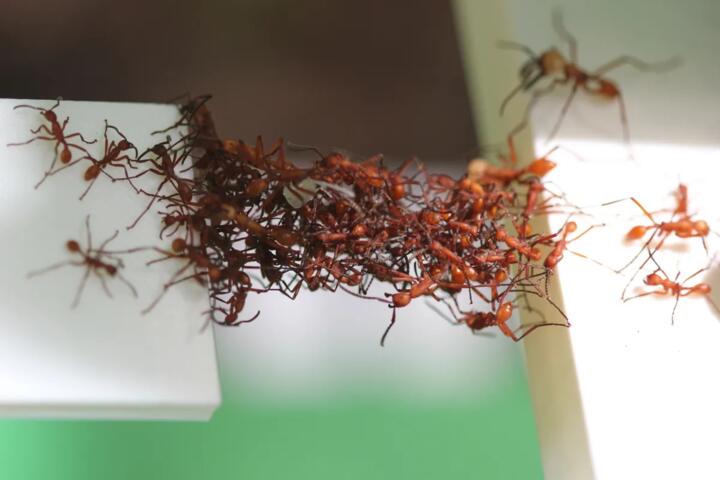
Ant colonies route traffic without a leader by turning local interactions into colony-wide patterns. Each ant follows simple rules based on what it senses on the ground, then its movement changes the environment for the next ant. Over time, those changes bias future movement toward routes that work, while weaker routes fade. A practical example is foraging: ants that find food return to the nest and lay pheromone, and later ants are more likely to choose the same corridor. When the corridor stops working, pheromone decays and the bias shifts to other paths, which is why the colony can adapt without a central map.
In real ant systems, the “routing table” is not stored in one place. It is encoded in pheromone concentration fields on surfaces, plus the ants’ internal state such as whether they are searching or returning. That encoding is distributed across many ants and many trail segments. The colony’s behavior emerges from feedback loops: successful routes get reinforced by repeated traffic, while unsuccessful routes lose reinforcement. This feedback loop is probabilistic, not deterministic, so the system keeps exploring even after it finds a good path.
Common Misconceptions And Dependencies
People often assume the colony uses a single best route that everyone copies. Ant behavior instead mixes exploitation and exploration: some ants follow stronger pheromone, while others sample alternatives. Another misconception is that ants “know” where food is; they do not. They react to local cues, so the colony’s global routing emerges from repeated local decisions.
Several dependencies shape how well the routing works. Pheromone deposition rate and evaporation rate determine how long a trail remains persuasive. If evaporation is too fast, ants keep relearning routes and the colony loses stability; if evaporation is too slow, outdated routes keep attracting ants even after conditions change. Ant sensing resolution matters too: if ants cannot distinguish nearby trail gradients, the bias becomes noisy. Finally, the environment matters because obstacles and surface texture affect movement and pheromone placement.
Supporting technologies in the real world show up when researchers translate ant routing into algorithms. Ant colony optimization (ACO) uses artificial “ants” that deposit and evaporate virtual pheromone on graph edges. In networking, similar ideas appear in distributed routing and swarm-based search, where nodes update local weights based on observed performance. These translations inherit the same sensitivity to parameter choices, and they also inherit the same limitation: local feedback can converge to suboptimal routes if exploration is insufficient.
One practical aside: many ACO tutorials use a default evaporation factor like 0.5 and a heuristic term that favors shorter edges, then they tune from there. That choice can look arbitrary, and it often is, because the best values depend on graph size, noise, and how quickly conditions change.
How Pheromone Creates Routes
Pheromone trails act like a distributed memory. When an ant travels from nest to food, it deposits pheromone along its path. Later ants that encounter that pheromone are more likely to follow it, which increases traffic on that path. The colony’s routing emerges because pheromone concentration becomes a proxy for route quality: routes that lead to food get reinforced more often. Evaporation prevents permanent lock-in by gradually removing pheromone, which lets the colony shift when a route becomes blocked or less productive.
The decision rule is typically probabilistic. An ant compares pheromone levels on candidate paths and chooses among them with probabilities proportional to pheromone strength (and sometimes a heuristic like path length). That probabilistic choice is what keeps the system from freezing on the first decent route it finds. If a new shortcut appears, ants exploring alternatives will discover it, and repeated successful trips will raise pheromone on the new segment. The colony then reallocates traffic toward the improved route as the pheromone gradient changes.
Another aside from algorithm work: in some ACO implementations, the pheromone update uses a “best-so-far” reinforcement term, which can speed convergence but also increases the risk of premature convergence. That mirrors a biological trade-off: too much reinforcement too quickly would reduce exploration, and ants do not behave like a single greedy optimizer.
Solutions And Advice For Mapping To Systems
Model Local Rules With Feedback
To map ant routing to a real system, start by defining the local sensing and local update loop. In an ACO-style model, each agent reads a local pheromone value on outgoing edges, chooses probabilistically, then deposits pheromone proportional to success. In a network analogy, each node can update a local weight based on observed delivery success or latency. A realistic outcome target is not “optimal in one run,” but “stable routing under moderate noise” and “re-routing within a bounded time after failure.” You can estimate that time by combining evaporation rate with update frequency; for example, if pheromone halves every T seconds, the influence of a failed route drops substantially after a few multiples of T.
Tune Evaporation For Adaptation
Evaporation controls how quickly the system forgets. If conditions change often, evaporation must be fast enough that stale routes lose influence before they dominate. If conditions change rarely, evaporation can be slower to reduce oscillation. In practice, tune evaporation by running controlled experiments on a representative graph or network topology. Track two metrics: route stability (how often paths change) and responsiveness (how quickly the system shifts after a simulated blockage). A mild frustration many teams hit: they tune only for responsiveness, then discover the system thrashes because trails decay too quickly and exploration never settles.
Keep Exploration Above Zero
Exploration prevents dead ends and supports discovery of shortcuts. In ant-inspired routing, exploration can be built into the probabilistic choice rule by ensuring that even low-pheromone edges retain some chance of selection. In networking terms, that can correspond to periodic probing, randomized multipath selection, or maintaining a small fraction of traffic on alternative routes. A practical number to watch is the exploration fraction: too low and the system can get stuck; too high and performance becomes inconsistent. You can choose a starting point by testing a range (for example, 1% to 10% exploration) and measuring delivery success rate and variance.
Instrument With Local Observability
Ant colonies do not expose logs, so engineers need instrumentation that mirrors local decision variables. In an ACO simulation, log pheromone levels and transition probabilities per edge. In a network experiment, log per-link metrics such as packet loss, queueing delay, and route-change events. This instrumentation helps you distinguish “the algorithm is exploring” from “the algorithm is failing.” If you see route changes without improvement in delivery metrics, the issue is often parameter mismatch or measurement noise, not the core idea.
Educational Case Examples
Blocked Corridor Re-Routing
Scenario: A colony foraging trail crosses a narrow passage. A temporary blockage forces ants to detour around an obstacle. Early ants still deposit pheromone on the blocked segment, but ants that discover the detour reinforce the alternative path. As evaporation reduces pheromone on the blocked segment, fewer ants choose it. The colony’s traffic shifts gradually rather than instantly, which reduces the chance of oscillation when the blockage clears. In a simulation, you would see pheromone concentration on the detour rise while the blocked edge’s pheromone decays.
Two Food Sources With Changing Quality
Scenario: Two food sources exist at different distances. One source yields less food per trip, so its reinforcement rate is lower. When the better source becomes depleted, ants returning from it deposit less pheromone because fewer trips succeed, while ants that find the other source keep reinforcing it. The colony’s routing bias shifts toward the route that currently produces more successful returns. In a graph model, this appears as a change in pheromone update strength tied to success, not just distance.
Comparison Table And Checklist
| Approach | How Decisions Form | Strengths | Common Failure Mode |
|---|---|---|---|
| Pheromone Feedback | Local sensing of trail gradients; probabilistic path choice; reinforcement on success; evaporation on time | Adapts to changes without a global map; distributed memory; continuous exploration | Stale trails dominate if evaporation is too slow; thrashing if too fast |
| Deterministic Shortest-Path | Global or semi-global computation; route selection based on fixed costs | Predictable behavior; easy to reason about under stable costs | Slow adaptation when costs change; can overload a single path |
| Randomized Multipath | Traffic split across candidate routes with fixed or adaptive weights | Reduces single-path overload; tolerates partial failures | Weights may not reflect real performance if feedback is weak |
Checklist for ant-inspired routing design:
- Define what counts as “success” for reinforcement (food found, delivery success, low loss, or short completion time).
- Choose an evaporation or forgetting mechanism tied to time or number of updates.
- Set a nonzero exploration probability so the system can discover alternatives after failures.
- Measure both stability (how often routes change) and responsiveness (time to shift after a change).
- Run tests with noise and partial failures, because local feedback amplifies measurement errors.
Common Mistakes
A frequent mistake is treating pheromone as a deterministic “truth.” In practice, pheromone is a bias signal that competes with exploration and noise. If you update pheromone only on the best observed route, the system can converge early and ignore better alternatives that appear later.
Another mistake is tuning parameters on a single static scenario. Ant-like routing depends on the rate of change in the environment, so a parameter set that works on a fixed graph can perform poorly when edges fail or costs drift. A mild annoyance in experiments: results can look good in one random seed and collapse in another, which signals insufficient exploration or overly aggressive reinforcement.
People also confuse “distributed” with “unbounded.” Distributed updates still require constraints such as maximum pheromone levels, bounded update rates, or caps on how much traffic can shift per time window. Without bounds, local feedback can create oscillations or excessive route churn.
Finally, avoid copying algorithm defaults without checking assumptions. For example, some ACO code samples label a parameter “alpha” for pheromone influence and “beta” for heuristic influence; the meaning matches the paper, but the scaling differs across implementations. I’ve seen a version mismatch in a lab notebook (ACO v2.1) where the parameter order was swapped, and the system “worked” only because the graph was small.
FAQ
Do Ants Use A Map Of The Area?
No. Ants rely on local cues like pheromone gradients and their immediate surroundings. The colony’s effective routing emerges from repeated local reinforcement and evaporation.
Why Doesn’t The Colony Get Stuck On One Trail?
Pheromone evaporates, so old trails lose influence. Probabilistic choice also keeps some ants sampling other paths, which helps the colony recover when conditions change.
What Controls How Fast Trails Fade?
Evaporation rate and the frequency of pheromone deposition. In models, these map to parameters that determine how quickly reinforcement loses weight over time.
How Do Ant-Inspired Algorithms Handle Failures?
They reduce the attractiveness of failed routes through evaporation and by reinforcing only successful transitions. If exploration is too low, recovery can be slow because the system may not discover alternatives.
Can This Idea Work In Computer Networks?
Yes in principle, but it depends on measurable feedback and bounded update behavior. Networking systems also face constraints like latency, packet loss, and fairness policies that ant behavior does not have to manage.
Author's Insight
Ant colonies route traffic without leaders by combining local sensing, probabilistic decisions, and feedback through pheromone deposition and evaporation. That feedback loop acts like distributed memory and a forgetting mechanism at the same time. When engineers translate the idea into routing algorithms, the key engineering challenge is parameter sensitivity: evaporation and reinforcement rates determine whether the system stabilizes or oscillates. Evidence from both biological studies and ant-inspired optimization literature supports the general mechanism, while exact parameter values vary by environment and implementation.
A practical way to evaluate the idea is to test it under controlled changes, such as blocking a corridor or increasing link loss, then measure how quickly the system shifts and how much it thrashes. If those metrics improve together, the approach is behaving like the biology it models; if responsiveness improves while stability collapses, the forgetting and exploration balance needs adjustment.
Key Takeaways
Ant colonies create routing without leaders by encoding route quality in pheromone fields that ants reinforce on success and erase through evaporation.
Probabilistic path choice keeps exploration alive, which prevents permanent lock-in to early routes.
Adaptation speed depends on the balance between reinforcement and forgetting, so parameter tuning must reflect how quickly the environment changes.
When translating the idea to algorithms or networks, measure both stability and responsiveness, and add bounds to prevent oscillation.