Man in Space
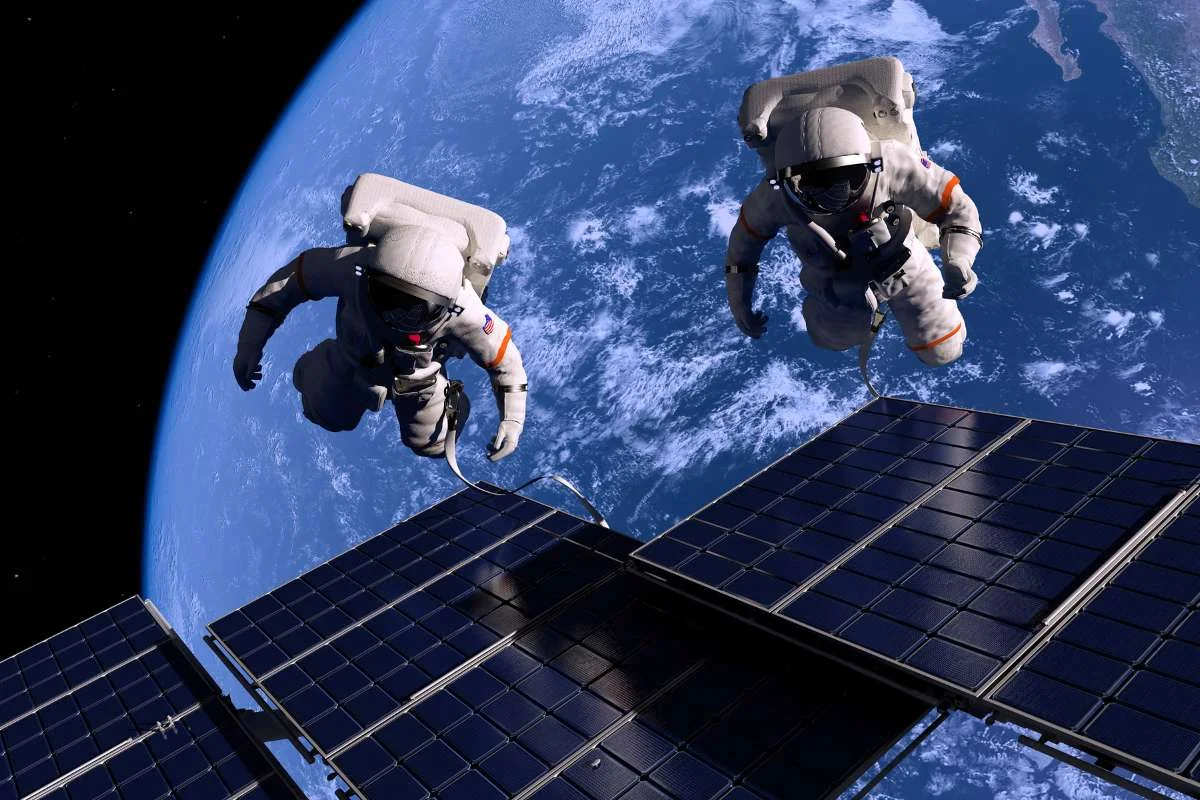
Long-term space exposure changes the body because several Earth conditions disappear at once: constant loading from gravity, familiar day-night cues, easy access to medical care, and the protection of the atmosphere and magnetic field. A person in orbit is not floating because gravity has vanished; the spacecraft and crew are falling around Earth together. That near-weightless setting changes how tissues sense force and how fluids move.
The clearest early effects include headward fluid movement, reduced leg and trunk muscle work, and a drop in bone mineral density. NASA reports average losses of about 1% to 1.5% per month in weight-bearing bones during four-to-six-month missions. The spine can also lengthen by as much as 3% in space as its normal compression eases. These figures describe averages, not a fixed forecast for every crew member.
Duration matters because adaptation and recovery are not identical events. A two-week flight may cause motion sickness and temporary fluid shifts, while a six-month stay adds deconditioning, bone remodeling, vision changes, and radiation exposure. A mission lasting a year or longer raises harder questions about cumulative dose, partial recovery, and the ability to work after landing.
Main Health Problems
Microgravity removes much of the load that normally stimulates bone maintenance. Cells that remove old bone continue working while cells that build new bone slow down, so the balance can shift toward weaker, more porous tissue. Calcium released from bone enters the urine, which raises kidney-stone risk and does not automatically restore strength when a crew member returns home.
Muscles also lose a daily workload. The calves, thighs, back, and muscles that hold the body upright are affected because walking and standing no longer demand the same force. The heart and blood vessels adapt to a smaller need for pumping against gravity. After landing, a returning astronaut may feel faint, tire quickly, or struggle to stand and walk until circulation and balance readjust.
Fluids move toward the chest and head instead of pooling in the legs. This shift can change facial appearance, alter pressure around the eyes, and contribute to spaceflight-associated neuro-ocular syndrome, or SANS. Researchers have found eye and optic-nerve changes on longer missions, but the cause is likely a mix of head pressure, blood-vessel filling, carbon dioxide, nutrition, genetics, and other factors rather than one simple mechanism.
The inner ear receives unfamiliar motion signals, so orientation and balance can suffer during arrival, orbit, and return. Sleep may also become less stable when a station passes through many sunrises each day, work demands stay high, and cabin noise continues. Immune responses can shift under the combined strain of confinement, altered sleep, radiation, and microgravity. Radiation adds a separate hazard: galactic cosmic rays and solar particles can damage tissue and raise long-term disease concerns.
What Helps In Orbit
Load Bones And Muscles
Crews use a treadmill with a harness, a cycle ergometer, and a resistive exercise device that simulates lifting against a load. A routine often approaches two hours per day, although the exact schedule depends on mission plans, equipment, health status, and research protocols. Resistive work targets hips, spine, and legs; aerobic work supports heart and lung fitness. Exercise reduces loss, but current routines do not erase every change, so postflight scans and rehabilitation remain necessary.
Manage Fluids And Nutrition
Fluid management starts with medical screening and continues through hydration, sodium review, and monitoring of urine and blood markers. Meals need enough energy, protein, vitamin D, and other nutrients for the mission plan; calcium balance receives close attention because bone breakdown can increase urinary calcium. Researchers also study lower-body negative pressure, a method that draws fluid toward the legs for a controlled period. No single meal or device fixes the whole fluid-shift problem.
Track Vision And Balance
Eye exams before, during, and after flight can include retinal images, pressure measurements, and optical coherence scans. Crew members also perform balance and movement tests so doctors can compare symptoms with sensorimotor data. A practical routine pairs these measurements with symptom reports: blurred vision, headache, nausea, trouble reading, or unusual dizziness deserves prompt review. Such tracking helps separate a temporary adjustment from a change that needs a modified workload or further examination.
Limit Radiation Dose
Mission planners combine shielding, storm shelters, exposure monitoring, and solar-weather forecasts. Aluminum and other spacecraft materials reduce some particles, but the highest-energy galactic cosmic rays are difficult to stop without adding too much mass. A crew member’s dose depends on trajectory, time, shielding, solar activity, and the particle mix. That is why a low-Earth-orbit result cannot simply be copied to a lunar or Mars mission.
Case Examples
Consider an anonymized astronaut after a six-month station mission. During flight, daily exercise preserves much of the person’s working capacity, yet the calf and hip still show measurable changes. On return, standing produces light-headedness and walking feels awkward. A supervised reconditioning plan, fluid assessment, strength work, and balance drills address separate causes rather than treating all symptoms as one problem.
Now consider a future crew member on a mission lasting well beyond a year. The medical team cannot assume that a familiar station routine will protect the skeleton for the full trip or that all lost capacity will return quickly. The crew may need repeated bone scans, dose tracking, vision checks, sleep scheduling, nutrition review, and plans for a strenuous task after landing. The scenario shows why mission duration changes risk management even when the spacecraft environment looks similar.
Decision Checklist
A useful way to judge a long-duration mission plan is to connect each body change with a measurement, a countermeasure, and a recovery plan. The checklist below is a compact decision aid for reading research or discussing mission readiness.
| Body system | Main driver | What to track | Planning response |
|---|---|---|---|
| Bone | Low mechanical load | Bone density and urine calcium | Resistive exercise, nutrition, follow-up |
| Muscle | Less daily work | Strength, size, exercise response | Aerobic and load-based training |
| Vision | Headward fluid shift | Retinal and symptom exams | Medical review and fluid studies |
| Radiation | Cosmic and solar particles | Personal dose and solar activity | Shielding and shelter procedures |
Common Mistakes
A common mistake is treating microgravity as simple relaxation. The body still works hard, but the work is redistributed: the arms may do more hand tasks while the legs lose routine loading. Another error is assuming exercise makes bone loss impossible. Training helps, yet dose, nutrition, genetics, mission length, and equipment quality affect the result.
People also confuse a return-to-Earth symptom with permanent damage. Dizziness, weakness, and poor balance can reflect a temporary transition, while some skeletal or eye changes may persist longer. The safer interpretation uses repeated measurements and clinical review instead of a single postflight feeling. Finally, station data should not be presented as a complete model for deep space. Radiation, distance, partial gravity, and limited rescue options change the setting.
FAQ
Does space make people taller?
Often, yes, for a short time. Spinal unloading can increase height by up to about 3% in orbit, with much of that change reversing after the return to Earth’s gravity.
How fast do bones weaken in space?
NASA cites an average loss of roughly 1% to 1.5% of mineral density per month in weight-bearing bones during many four-to-six-month missions, although individual results vary.
Can astronauts regain lost muscle?
Exercise and rehabilitation can restore much of the working capacity, but recovery speed differs by muscle group, mission length, age, training, and the demands placed on the body after landing.
Why do astronauts report vision changes?
Headward fluid movement may change pressure and blood flow around the brain and eyes. Carbon dioxide, nutrition, genetics, and other factors may also contribute to SANS.
Is space radiation the same as an X-ray?
No. Space crews encounter solar particles and galactic cosmic rays with varied energies and particle types, so dose and shielding behavior differ from a routine medical X-ray.
Author's Insight
Long-term space exposure is best understood as a linked set of adaptations rather than a single disease. Reduced loading, fluid redistribution, radiation, sleep disruption, and isolation can interact, so a countermeasure aimed at one system may not solve another system’s problem. The strongest research combines scans, exercise records, biological samples, symptoms, and postflight follow-up across different mission lengths. Current evidence supports careful preparation, while the small number of long-duration crews means that uncertainty remains part of every deep-space plan.
Key Takeaways
Months in orbit can reshape bones, reduce muscle demand, shift fluids toward the head, disturb balance, affect vision, alter cardiovascular responses, and add radiation exposure. Exercise, nutrition, monitoring, shielding, sleep routines, and rehabilitation reduce risk, but they do not make the body unchanged. A station mission offers useful evidence, yet a lunar or Mars journey will add different gravity, distance, radiation, and rescue limits. Readers should treat headline numbers as averages and ask how the mission duration, measurement method, and recovery period affect the conclusion. Recovery planning also depends on the first task after landing, because a crew member may need to walk, lift equipment, or respond to an emergency before full conditioning returns.