What Glass Really Is
Glass begins as a liquid mixture, but the finished material is an amorphous solid: its atoms sit in a disordered network rather than a repeating crystal lattice. In common soda-lime glass, silicon and oxygen form the main network, while sodium, calcium, and other ingredients modify its bonding and melting behavior. Neighboring atoms still have fairly consistent distances and bonding patterns, called short-range order. Farther away, those patterns do not repeat with the regular spacing found in quartz or table salt.
Cooling changes motion more than it changes the broad arrangement. A hot melt lets atoms rearrange quickly. As temperature falls, viscosity rises and rearrangements take longer. The material passes through a glass-transition range rather than one universal freezing point; the range shifts with composition and cooling rate. A useful laboratory convention treats a liquid as glassy when structural relaxation takes longer than about 100 seconds, though that boundary is a measurement choice, not a sudden atomic switch. At room temperature, ordinary window glass relaxes so slowly that visible flow is not a practical process.
That description resolves the apparent contradiction. Glass is not a liquid quietly draining under gravity during a normal human lifetime, yet it is not a crystal at equilibrium either. Its atoms are trapped in a nonequilibrium arrangement that can retain the shape imposed during manufacture.
Why The Liquid Myth Persists
Old windows often have thicker lower edges, which seems to show that glass flowed downward. Historical glassmaking offers a better explanation: sheets were uneven because craftsmen spun, rolled, cast, or installed them with variable thickness. Some panes were placed with the thicker edge at the bottom, but that orientation reflects selection during installation, not a universal flow rule.
The word “liquid” also creates confusion because viscosity has no sharp upper limit. Honey, asphalt, and molten glass can all resist motion to different degrees. A fluid can keep deforming under sustained stress, while a solid can support a fixed shape on ordinary time scales. Glass sits near that boundary in a time-dependent way: shorten the observation time and it behaves more rigidly; wait for far longer and its frozen structure may relax.
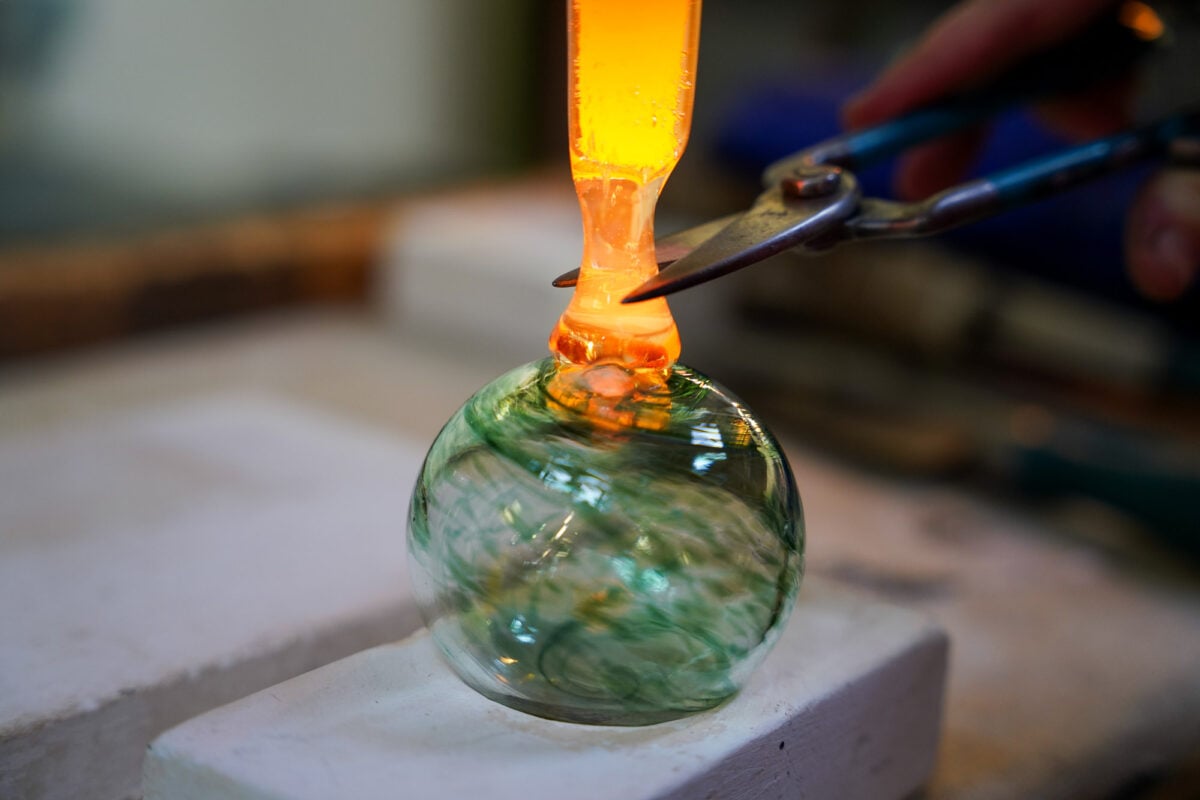
Heat makes the distinction visible. A glassblower heats a workpiece until atoms rearrange rapidly enough for shaping. Cooling then arrests that rearrangement. The piece does not turn from liquid to crystal; it moves from a mobile supercooled melt into a glassy state. Internal stresses can remain if cooling is too fast or uneven, which is why industrial glass may be annealed before use.
How To Read Atomic Motion
Separate Local And Long Range Order
Start by asking what kind of order a measurement detects. Diffraction from a crystal produces sharp peaks because many repeating unit cells reinforce the same spacing. Amorphous glass produces broad halos. Those halos still contain information about nearest-neighbor distances, bond angles, and network connectivity. A disordered pattern is not the same as a random gas; local chemical bonds constrain the atoms even when no large-scale lattice exists.
In silica-rich glass, each silicon atom commonly sits near four oxygen atoms in a tetrahedral arrangement. The tetrahedra connect through shared oxygen atoms, but their orientations vary across the sample. Modifiers such as sodium interrupt some network connections and make ion movement easier at high temperature. This local-network picture explains why glass can be hard and transparent while still differing from a crystal at larger distances.
Track Viscosity And Relaxation
Viscosity measures resistance to flow, while relaxation time measures how long a structure takes to rearrange after a disturbance. They are related but answer different questions. A glass sample may support its own weight for centuries because its relaxation time is enormous, even though its atoms vibrate continuously. Those vibrations are small oscillations around temporary positions, not the coordinated displacement needed for macroscopic flow.
For a practical test, change the temperature and observe the time scale. A furnace can make glass workable, while a room-temperature pane remains dimensionally stable. The exact temperature at which a sample becomes shapable depends on its recipe and thermal history. A borosilicate laboratory vessel and a soda-lime bottle do not share one glass-transition temperature.
Account For Cooling History
Glass records how it was cooled. Slow cooling gives atoms more opportunities to find lower-energy arrangements and can reduce internal stress. Rapid cooling freezes the structure sooner and may preserve more excess volume. The same chemical mixture can therefore show different density, hardness, and relaxation behavior after different thermal schedules.
Manufacturers use annealing to pass slowly through a temperature interval where stresses can relax. A familiar example is tempered glass: controlled heating and rapid cooling create surface compression, which changes how cracks grow. Tempering does not turn amorphous glass into a crystal. It changes the stress state and the way a fracture progresses.
Use The Right Atomic Model
A useful mental model is a crowded network with many local arrangements, not a bag of loose beads and not a perfect grid. Each atom experiences bonding forces from nearby partners, while the whole network contains irregular rings, bond angles, and small defects. Thermal energy constantly shakes this network. A large rearrangement requires several local bonds or cages to cooperate, so the rate falls dramatically as the material cools.
Researchers study these patterns with diffraction, spectroscopy, calorimetry, and molecular simulations. A calorimetry scan may show a glass-transition step rather than a crystal’s sharp melting event. A diffraction pattern tests long-range repetition. Used together, these methods connect the everyday property—rigidity—to structure and motion at scales far below a millimeter.
Two Everyday Case Examples
Consider an old church pane with a visibly uneven edge. An informed inspection would first examine manufacturing marks, frame geometry, and whether neighboring panes share the same orientation. Uneven thickness is expected from historical production. The pane’s shape alone cannot establish that it flowed over several centuries.
Now consider a laboratory bottle that cracks after a sudden temperature change. The likely lesson is thermal stress, not liquid-like downward motion. The outer surface cools or heats before the interior, producing different expansion across the wall. Annealing, suitable wall thickness, and gradual temperature changes reduce that risk. The atoms remain in an amorphous network in both the intact and cracked samples; the difference is the stress distribution.
Solid, Liquid, Or Crystal?
| Feature | Crystal | Glass | Liquid |
|---|---|---|---|
| Atomic order | Repeating long-range lattice | Local order without a repeating lattice | Local structure with ongoing rearrangement |
| Shape | Fixed on ordinary time scales | Fixed on ordinary time scales | Takes the container’s shape |
| Heating behavior | Sharp melting point for a pure phase | Softens across a range | Already mobile |
| Best question | What repeats? | How fast can it relax? | How readily does it rearrange? |
The table is a guide to behavior, not a claim that nature has only three boxes. Glass transition depends on time, temperature, pressure, composition, and prior treatment. For a real sample, pair a simple observation with a measurement such as thermal analysis or diffraction.
Common Glass Misreadings
Calling every transparent solid a liquid misses the role of structure and time. Some polymers, gels, and metallic glasses are amorphous too, but their bonding and motion differ from those of a silica-based pane. The label alone does not predict strength, softening range, or optical behavior.
Another error is treating the glass-transition temperature as a universal constant. Recipe and cooling rate shift the observed range, and different test methods use different time scales. A value from a borosilicate datasheet should not be transferred to a bottle made from another composition.
A third mistake is using density as a complete structural description. Two glasses can have similar density while differing in local chemical order, defects, or stress. Measurements need context: diffraction, thermal history, and composition each reveal a different part of the picture.
Finally, do not infer atomic flow from a crack, sagging frame, or warped support. Check gravity, mounting, thermal gradients, mechanical load, and manufacturing tolerances first. Those causes act on ordinary time scales and are easier to test.
FAQ
Does glass flow at room temperature?
Its atoms vibrate and rare rearrangements may occur, but ordinary glass relaxes so slowly that it does not measurably flow like a liquid in everyday use.
Why are old windows thicker at the bottom?
Historical forming methods made uneven panes, and installers often placed thicker edges downward; that pattern does not demonstrate centuries of gravitational flow.
Is glass an amorphous solid?
Yes. It lacks a crystal’s repeating long-range lattice while retaining constrained local bonding, so it is classed as an amorphous solid.
What happens at the glass transition?
As a melt cools, coordinated atomic rearrangements slow until the structure is effectively frozen on the chosen observation time scale.
Can heating turn glass into a crystal?
Heating usually softens the network, but controlled conditions can also permit crystallization; the result depends on composition, temperature, and time.
Author's Insight
The most useful answer is time-dependent: glass is solid in ordinary handling and a highly viscous supercooled material in its thermal history. Atomic vibration does not equal macroscopic flow, because large rearrangements require cooperative motion through a bonded network. The glass transition is therefore a kinetic arrest, not a simple category boundary marked by one universal temperature. This framework explains both the durability of a pane and the ease with which a furnace can reshape it.
Key Takeaways
Glass is an amorphous solid with local atomic order but no repeating crystal lattice. Cooling raises viscosity and lengthens structural relaxation until the network cannot rearrange on practical time scales. Uneven old panes usually reflect historical manufacture, while cracks commonly reflect stress and temperature gradients. To assess a real sample, ask about composition, cooling history, measurement time, and the evidence used to describe its structure.