Falling Into A Black Hole
“Falling into a black hole” describes motion under gravity in general relativity, not a cinematic event. The event horizon marks a boundary beyond which signals cannot reach a distant observer, even at the speed of light. For a non-rotating (Schwarzschild) black hole, the horizon radius is r_s = 2GM/c^2, so mass sets the scale. For example, a 10-solar-mass black hole has r_s about 30 km, while a 4-million-solar-mass black hole has r_s about 12 million km. A key prediction is that the horizon changes what light can escape, not that gravity suddenly turns on at the horizon.
Time behaves differently for different observers. A distant observer sees infalling matter slow down and fade as it approaches the horizon, because signals are increasingly redshifted and delayed. In contrast, an infalling observer’s proper time to cross the horizon remains finite in classical general relativity. Tidal forces, not the horizon itself, drive the most dramatic physical effects when the black hole is small enough and the infaller is close enough to the center. In practice, the “feel” of falling depends on black hole mass, spin, and the infaller’s trajectory, which is why popular accounts often oversimplify.
Common Misconceptions
Many accounts mix up three different ideas: crossing the horizon, reaching the singularity, and being torn by tides. The horizon is a causal boundary; the singularity is a breakdown of the classical theory where curvature becomes infinite in the simplest models. Tidal disruption depends on how steeply the gravitational field changes across the body, which depends on distance from the black hole and on its mass. People often assume the horizon is where tides become extreme, but for large black holes the horizon can be crossed with relatively mild tidal effects. For small black holes, tides can become severe well before reaching the singularity.
Another common error is treating “what you see” as the same for all observers. A distant observer’s view is dominated by gravitational redshift and time dilation, so the infaller’s signals arrive stretched and dimmed. An infaller’s local measurements follow their own proper time, so they do not experience the same slowing. This mismatch produces the famous paradox-like descriptions, but it is resolved by recognizing that different observers use different time coordinates. The physics does not require a contradiction; it requires careful language.
Interpret Prediction Solutions
Separate Horizon From Singularity
When reading about black holes, treat the event horizon as a causal boundary and the singularity as a classical-theory limit. This works because general relativity predicts horizon crossing without a local “wall” in the simplest models, while the singularity marks where the model stops. In practice, ask whether a source claims “you hit the horizon and die instantly,” which is not a standard prediction. A useful check is whether the description mentions causal escape of light, not just “extreme gravity.”
Use r_s scaling for intuition. For a 10-solar-mass black hole, r_s is about 30 km, so the horizon is not astronomically large. For a supermassive black hole of 4 million solar masses, r_s is about 12 million km, which changes tidal severity at the horizon. This scaling helps you judge whether “mild crossing” or “rapid disruption” is plausible in a given scenario.
Track Observer Frames Clearly
Decide which observer the description refers to: a distant observer, a hovering observer outside the horizon, or the infaller. This works because time dilation and redshift affect distant signals, while the infaller’s proper time follows their own clock. In practice, look for phrases like “as seen from far away,” which usually implies redshift and fading. If a source describes the infaller’s experience as if it were measured by a distant camera, treat it as a narrative shortcut.
A mild frustration is common here: many explanations compress multiple frames into one story. To avoid that, map each claim to a frame and a measurement type, such as “arrival time of light” versus “local acceleration.” If the source cannot identify the frame, the claim is hard to verify.
Use Tidal Forces As The Physical Driver
Focus on tidal forces rather than the horizon location alone. This works because tidal stretching depends on curvature gradients, which scale with black hole mass and distance. In practice, ask whether the scenario specifies mass and trajectory, since those determine whether a human-sized body experiences spaghettification-like stretching. For large black holes, tidal effects at the horizon can be small enough that disruption might occur later, while for smaller ones disruption can occur sooner.
For a quick sanity check, compare black hole mass categories. Stellar-mass black holes have horizons tens of kilometers across, while supermassive ones have horizons millions of kilometers across. Larger horizons generally mean weaker gradients at the horizon for the same relative approach, though spin and trajectory can shift details. This is a qualitative guide, not a medical prediction.
Account For Radiation And Accretion Environment
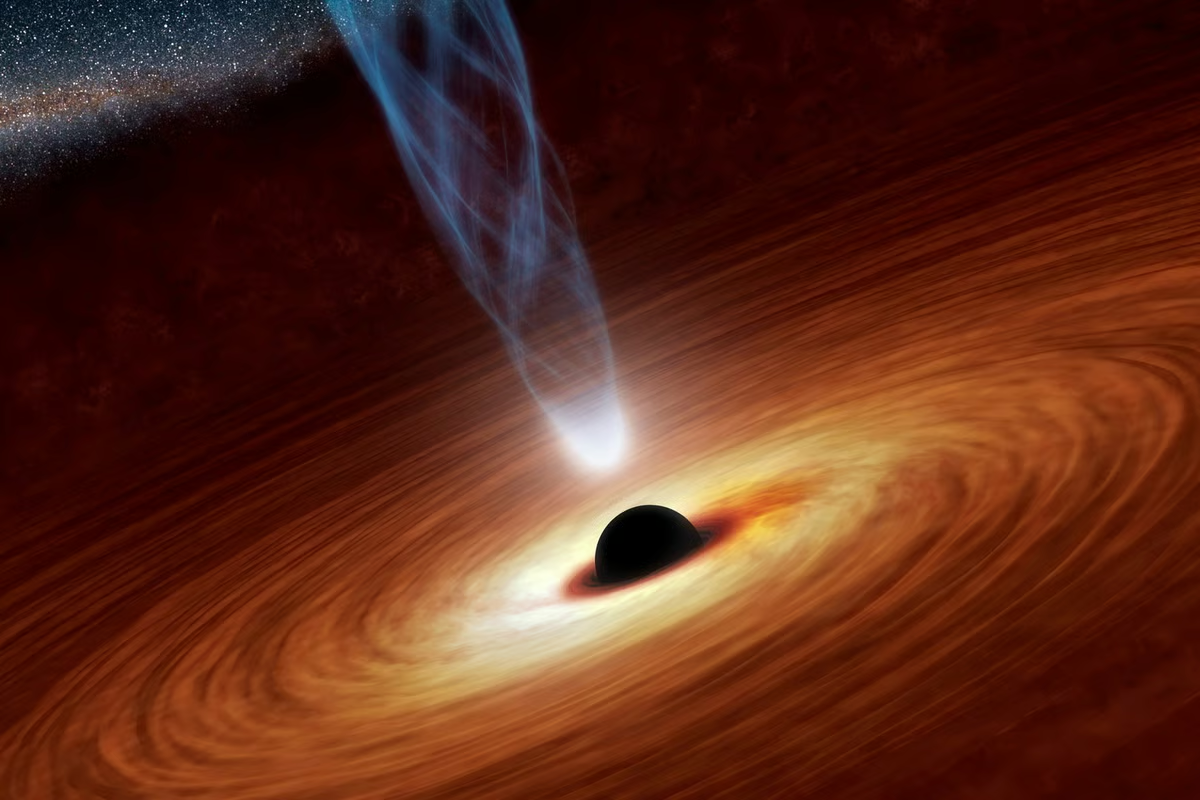
Include the accretion disk and jet environment when evaluating “hazards.” This works because real black holes often sit in regions with hot plasma, magnetic fields, and intense radiation. In practice, a person falling into a bright accretion flow could face heating and particle impacts before horizon crossing. A low-luminosity black hole might offer a different hazard profile even with the same mass.
When a source ignores the environment, treat its “experience” claims as incomplete. I’ve noticed that popular accounts often assume vacuum conditions, which is rarely true near active galactic nuclei. If the scenario does not mention radiation fields, it cannot support a realistic sensory timeline.
Interpret Simulations With Known Limits
Read simulation-based descriptions as model outputs with assumptions. This works because ray-tracing and numerical relativity typically assume a spacetime metric and a simplified emission model. In practice, check whether the scenario uses Schwarzschild or Kerr geometry, and whether it includes an accretion disk. A detail like “version 1.2 of a public ray-tracing tool” can matter because code updates sometimes change defaults, though the underlying physics remains the same.
Also watch for coordinate artifacts. Coordinate time can diverge at the horizon in some coordinate systems, which can be misread as “the infaller never crosses.” The correct interpretation uses proper time for the infaller. If a source does not distinguish these, treat its timeline claims cautiously.
Educational Case Examples
Case 1: Distant View Of Fading
An anonymized observer watches a compact object fall toward a non-rotating black hole. The observer sees the infalling material’s light become increasingly redshifted and delayed, so the source appears to slow and dim as it nears the horizon. The pattern can include multiple distorted images due to strong lensing and photon orbits near the photon sphere. The infaller’s local clock does not show the same slowing, which is why the distant and local descriptions differ. This scenario teaches frame separation rather than “one shared video feed.”
Case 2: Tides Depend On Mass
An anonymized crew plans a thought experiment with two black holes: one stellar-mass and one supermassive. In the stellar-mass case, tidal gradients near the horizon can become large enough to disrupt a human-sized body over a short proper-time interval. In the supermassive case, the same body size can experience milder gradients at the horizon, shifting the dominant hazard to later regions or to environmental radiation. The lesson is that “falling into a black hole” is not one experience; it is a family of outcomes governed by mass, spin, and trajectory. This example also highlights why sources that omit mass should be treated as less informative.
Checklist For Readers
| Claim Type | What To Look For | What It Usually Means | Trust Level |
|---|---|---|---|
| Horizon Crossing | Mentions causal boundary and proper time | Local crossing without a “wall” in classical models | Higher when framed correctly |
| Distant “Fading” | Mentions redshift and signal delay | Distant observer sees slowing and dimming | Higher when tied to light propagation |
| “Spaghettification” Timing | Specifies mass and trajectory | Tidal disruption depends on gradients | Lower when mass is missing |
| Singularity Details | Acknowledges classical breakdown | Quantum gravity unknowns dominate | Lower for sensory claims |
Step-by-step checklist for evaluating a description: identify the black hole type (non-rotating vs rotating), identify the observer frame, check whether the claim uses proper time or coordinate time, look for mass and environment assumptions, and treat “felt sensations” as qualitative unless the source maps them to measurable forces and radiation. If any step is missing, downgrade confidence.
Mistakes That Mislead
One mistake is claiming that crossing the event horizon takes infinite time for the infaller. That confusion comes from mixing coordinate time with proper time. Another mistake is treating the horizon as a physical surface that burns or crushes, which is not part of the standard classical prediction for a smooth horizon in idealized models. A third mistake is ignoring spin, which changes the geometry and can alter light paths and infaller trajectories. A fourth mistake is using “spaghettification” as a universal script, even though tidal severity depends on mass and approach.
Readers also get misled by the phrase “you would see yourself.” Some versions are based on light looping near the photon sphere, but the timing and appearance depend on geometry, emission direction, and observer location. If a source does not specify those details, the claim becomes a story rather than a physics result. Finally, many explanations skip the accretion environment, which can dominate hazards through radiation and particle flux. That omission matters for any attempt to connect physics to bodily effects.
FAQ
Does The Event Horizon Feel Like A Wall
Classical general relativity predicts that a freely falling observer crosses a smooth event horizon without encountering a local “wall,” assuming an idealized black hole with no extreme local radiation or matter. Real environments can still cause severe harm before or during crossing.
Why Does A Distant Observer See Slowing
A distant observer receives light that is increasingly redshifted and delayed as the infalling matter approaches the horizon. The observed brightness and timing change because light propagation in curved spacetime stretches signals.
What Causes Tidal Stretching
Tidal forces arise from gradients in the gravitational field across the body. Their strength depends on black hole mass, spin, and distance from the center, so tidal disruption timing varies widely across scenarios.
Can Light Escape After Crossing
After crossing the event horizon, signals emitted outward cannot reach a distant observer because the causal structure prevents escape. This is the defining feature of the event horizon.
Are Singularity Experiences Known
Classical models predict a breakdown at the singularity, and quantum gravity effects are not settled. That limits reliable claims about what happens deep inside beyond the horizon.
Author's Insight
Most “what it feels like” descriptions fail because they blend observer frames and mix horizon physics with singularity speculation. The most defensible mental model separates causal escape (horizon), local proper-time evolution (infall), and tidal gradients (physical stretching). Environmental radiation near accretion flows can dominate hazards, so vacuum-only thought experiments do not map cleanly to bodily outcomes. A careful reader can still learn a lot by checking which assumptions a source states and which it leaves implicit.
Key Takeaways
- The event horizon is a causal boundary; it does not automatically act like a physical surface for a freely falling observer in idealized classical models.
- Distant “slowing and fading” comes from redshift and signal delay, not from the infaller’s proper time.
- Tidal forces depend on black hole mass, spin, and trajectory; “spaghettification” timing is not universal.
- Accretion disks and radiation fields can create hazards before horizon crossing, so environment matters.
- Claims about what happens at the singularity remain uncertain because classical general relativity breaks down there.