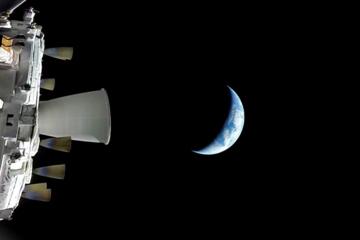
Radiation Beyond Earth Orbit
Orion’s radiation approach targets a mix of particle types that behave differently in spacecraft materials. Outside Earth orbit, the dominant sources shift toward galactic cosmic rays and solar energetic particles, with fewer layers of Earth’s magnetic shielding. The spacecraft also experiences trapped radiation in certain regions near Earth, but the “beyond Earth orbit” environment changes the balance of risk. For practical understanding, think of radiation as a dose from particles that either pass through, scatter, or deposit energy in tissue. Orion’s design choices aim to reduce dose rates and to keep uncertainty bounded enough for mission planning.
Radiation risk is usually discussed in terms of dose and biological effects, not a single “radiation level.” Dose estimates depend on particle spectra, shielding thickness and composition, and where the crew sits relative to structure. Orion’s crew module geometry matters because shielding is not a uniform slab; it is a set of walls, equipment bays, and internal surfaces. A small change in assumed material placement can shift predicted dose, which is why planners rely on validated transport models and conservative assumptions. On a mission timeline, the dose accumulation is also time-dependent, since solar events can raise particle flux for hours to days.
Main Problems And Pain Points
People often underestimate how many variables drive radiation exposure. Shielding effectiveness depends on particle energy, not just total mass. High-energy galactic cosmic rays can penetrate deeply, so “more shielding” does not translate into a simple linear reduction in dose. Solar energetic particles can be more intense over shorter periods, so timing and operational response matter. Another common misunderstanding treats radiation as a single hazard, when the biological outcomes differ across dose rate, particle type, and depth of penetration.
Orion’s radiation handling also depends on supporting technologies that sit outside the spacecraft hull. Mission planners use radiation transport and dose models that simulate how particles interact with materials. These models need inputs such as solar event forecasts, galactic cosmic ray spectra assumptions, and spacecraft mass distribution. Uncertainty stays in the system because space radiation measurements vary with solar cycle and because shielding is complex. A related pain point is that “shielding” can create secondary particles when primary particles interact with materials, which can move dose around rather than remove it.
Operational constraints add another layer of complexity. Crew time in specific locations, such as during maneuvers or after a solar particle event begins, affects cumulative dose. If a mission uses a shelter-in-place strategy, the shelter location and the crew’s access to it become part of the radiation plan. Orion’s design includes a crew module that functions as a primary shelter, but the exact effectiveness depends on how much of the module’s structure is treated as shielding in the dose model. That modeling detail rarely makes it into public summaries, and it can be the difference between a conservative estimate and an optimistic one.
Solutions And Advice
Use Dose Models With Limits
Start with the dose modeling framework used for mission planning, then check what assumptions drive the result. Orion planners typically rely on radiation transport codes and validated dose conversion factors, then apply operational limits tied to mission risk criteria. A practical way to evaluate claims is to ask whether the estimate includes uncertainty ranges and whether it accounts for both galactic cosmic rays and solar energetic particles. If a summary only reports a single number without uncertainty, it usually hides the variability that matters for decision-making. For readers, the actionable takeaway is to treat radiation numbers as planning estimates, not guarantees.
One small aside from how these reports are often written: you may see versioned model packages in internal documentation, and public-facing summaries sometimes omit the version. If you encounter a figure without context, look for the date of the underlying model update in the source material. That date can matter because particle spectra assumptions and cross-section libraries get revised. For example, a model update around 2020 could change predicted dose by a few percent to tens of percent depending on energy range, which is enough to affect risk margins.
Rely On Crew Module Shielding
Orion’s crew module provides the main shielding layer, and its effectiveness comes from both material choice and geometry. The crew module uses structural materials and internal components that contribute to stopping and scattering particles. Designers also consider where mass sits relative to the crew, because shielding “behind” the crew matters more than shielding far away. In practice, the crew module is not a single material wall; it is a layered system that includes pressure vessel structure and equipment. The best way to interpret this is to compare shielding as “dose reduction in the crew region,” not “thickness on paper.”
Shielding tradeoffs show up in mass and thermal constraints. Adding shielding increases mass, which increases launch cost and affects trajectory options. That is why spacecraft designers often pursue targeted shielding and geometry rather than uniform thick walls. A mild frustration for readers is that public discussions sometimes imply that shielding is only about thickness, when secondary particle production and energy-dependent penetration dominate the outcome. For Orion, the crew module’s role as a shelter is central, and the rest of the spacecraft structure contributes as well, depending on the modeled particle paths.
Plan Operations Around Solar Events
Operational response reduces dose during solar energetic particle events. Mission planners monitor space weather inputs and use predefined procedures to decide when to shelter. The shelter strategy depends on the expected particle energies and the time it takes for particles to arrive after a solar event begins. In many mission concepts, the crew spends more time in the most shielded volume during elevated flux periods, which reduces dose rate compared with remaining in less shielded areas. Readers can evaluate operational plans by checking whether they describe trigger criteria and shelter duration assumptions.
As a concrete example of what “operational” can mean, some missions use real-time alerts from space weather monitoring systems and then adjust crew schedules. The exact trigger thresholds are mission-specific and not always public, but the mechanism is consistent: reduce exposure when flux rises. If a source claims a shelter strategy without describing how it is activated, the claim is hard to verify. A practical next step for readers is to look for references to space weather monitoring and risk criteria in mission documentation, rather than relying on simplified summaries.
Track Dose With Monitoring And Procedures
Radiation monitoring helps convert models into mission-specific estimates. Orion missions can use dosimeters and radiation sensors to measure dose rates and to support post-flight analysis. Monitoring does not remove uncertainty, but it helps validate model predictions and refine future planning. A realistic outcome is that measured dose can differ from preflight estimates because actual particle spectra and spacecraft configuration vary. When the monitoring data is available, analysts can compare predicted versus measured dose and adjust model parameters for subsequent missions.
For readers, the useful question is what the monitoring system measures: dose rate, particle counts, or energy deposition proxies. Different sensors respond differently to particle types, and that affects how you interpret the data. If a report only says “radiation monitored” without describing sensor type or placement, it provides limited decision support. A mild aside: sensor placement inside a crew module can be constrained by life-support and crew operations, so the “best” location for measurement may not match the “best” location for shielding.
Case Examples
Example 1: Solar Particle Alert
An anonymized scenario involves a crew on a mission beyond Earth orbit receiving a solar energetic particle alert. The mission team activates a shelter procedure that keeps the crew in the most shielded portion of the crew module for the duration of elevated flux. Preflight models predicted a certain dose increment for a typical event profile, but the event’s intensity and timing shift the actual dose rate. Dosimeter readings show higher dose rate early in the event, then a decline as the particle spectrum softens. After the event, analysts compare sensor data to model predictions to refine the event profile assumptions for future planning.
Example 2: Long Cruise With Uncertain Spectra
Another anonymized scenario covers a longer cruise phase where galactic cosmic ray exposure accumulates steadily. The mission plan uses a conservative galactic cosmic ray spectrum assumption based on solar cycle conditions, then applies uncertainty margins. During the cruise, radiation sensors record dose rates that fall within the predicted range but not exactly at the midpoint. The crew’s operational schedule remains unchanged because there is no solar event trigger, so the main mitigation comes from the crew module’s baseline shielding. Post-mission analysis focuses on how the measured dose rate compared with the model’s energy-dependent assumptions, which can influence risk margins for later missions.
Comparison Table And Checklist
| Decision Point | What To Look For | What It Means For Dose | Common Red Flag |
|---|---|---|---|
| Shielding claim | Crew-region dose reduction, not just wall thickness | Energy-dependent penetration and secondary particles | Single-number “radiation blocked” statements |
| Solar event plan | Trigger criteria and shelter duration assumptions | Dose rate reduction during elevated flux | Shelter described without activation logic |
| Modeling uncertainty | Uncertainty ranges and model validation references | Risk margins depend on spread, not the mean | No mention of uncertainty or validation |
| Monitoring | Sensor type and placement inside the crew module | Measured dose supports model calibration | “Monitored” with no measurement details |
Checklist you can use when reading mission radiation summaries: confirm which radiation sources are included (galactic cosmic rays, solar energetic particles, and any near-Earth trapped components); check whether the estimate is for dose to the crew region; look for uncertainty ranges; verify whether operational sheltering is described with triggers; and check whether monitoring data is planned for post-flight comparison. If a source skips two or more of these items, treat its dose numbers as incomplete.
Common Mistakes
A frequent mistake is treating radiation as a single “safe or unsafe” threshold. Biological risk depends on dose, dose rate, and particle characteristics, so a single threshold oversimplifies the physics and the risk model. Another mistake is assuming that shielding always reduces dose proportionally. In reality, secondary particles can increase dose in some regions even when primary particles are reduced. People also confuse “radiation outside” with “radiation inside,” forgetting that spacecraft materials can change the particle mix reaching the crew.
Readers also encounter promotional-style phrasing that implies radiation is fully solved by hardware. Orion’s approach combines shielding, geometry, operational procedures, and measurement, and each piece has limits. If a summary claims that shielding makes dose negligible, it conflicts with the known penetration of high-energy cosmic rays. A final practical mistake is ignoring uncertainty. Dose estimates carry model and input uncertainty, and risk margins exist because planners cannot predict every solar event profile or particle spectrum exactly.
FAQ
What Radiation Types Affect Orion?
Beyond Earth orbit, Orion faces galactic cosmic rays and solar energetic particles, with additional near-Earth trapped radiation depending on the mission phase. These sources differ in energy spectrum and time variability, so shielding and operations target both steady and event-driven exposure.
Does Orion Use Thick Shielding Everywhere?
Orion’s shielding is concentrated around the crew module rather than distributed as uniform thickness across the entire spacecraft. Dose reduction depends on where mass sits relative to the crew and how particles interact with layered materials.
How Do Solar Events Change Crew Dose?
Solar energetic particle events raise particle flux for limited periods, which increases dose rate. Mission procedures can reduce exposure by keeping the crew in the most shielded volume during elevated flux.
How Are Radiation Estimates Verified?
Radiation transport models are validated against available measurements and then compared with in-mission dosimeter or sensor data when available. Differences between predicted and measured dose help refine assumptions for later missions.
Can Monitoring Replace Shielding?
Monitoring supports measurement and model calibration, but it does not prevent exposure. Shielding and operational sheltering reduce dose during the mission, while monitoring helps quantify what actually occurred.
Author's Insight
Orion’s radiation handling rests on a layered logic: reduce dose through crew-module shielding, reduce event-driven exposure through shelter procedures, and quantify outcomes with radiation monitoring. The physics behind dose is energy-dependent, so “more shielding” does not translate into a simple proportional benefit. Public summaries often compress uncertainty and operational details, which can make dose numbers feel more certain than they are. A careful reading focuses on what sources are included, how the crew-region dose is computed, and whether uncertainty ranges and validation steps are described.
Key Takeaways
- Beyond Earth orbit, galactic cosmic rays and solar energetic particles drive most crew radiation risk, and they behave differently in shielding.
- Orion’s mitigation emphasizes the crew module as a shelter, where geometry and layered materials determine dose reduction.
- Operational response to solar events reduces dose rate during elevated flux, and the plan depends on triggers and shelter duration assumptions.
- Radiation monitoring supports model validation and post-mission dose accounting, but it cannot replace shielding or sheltering.