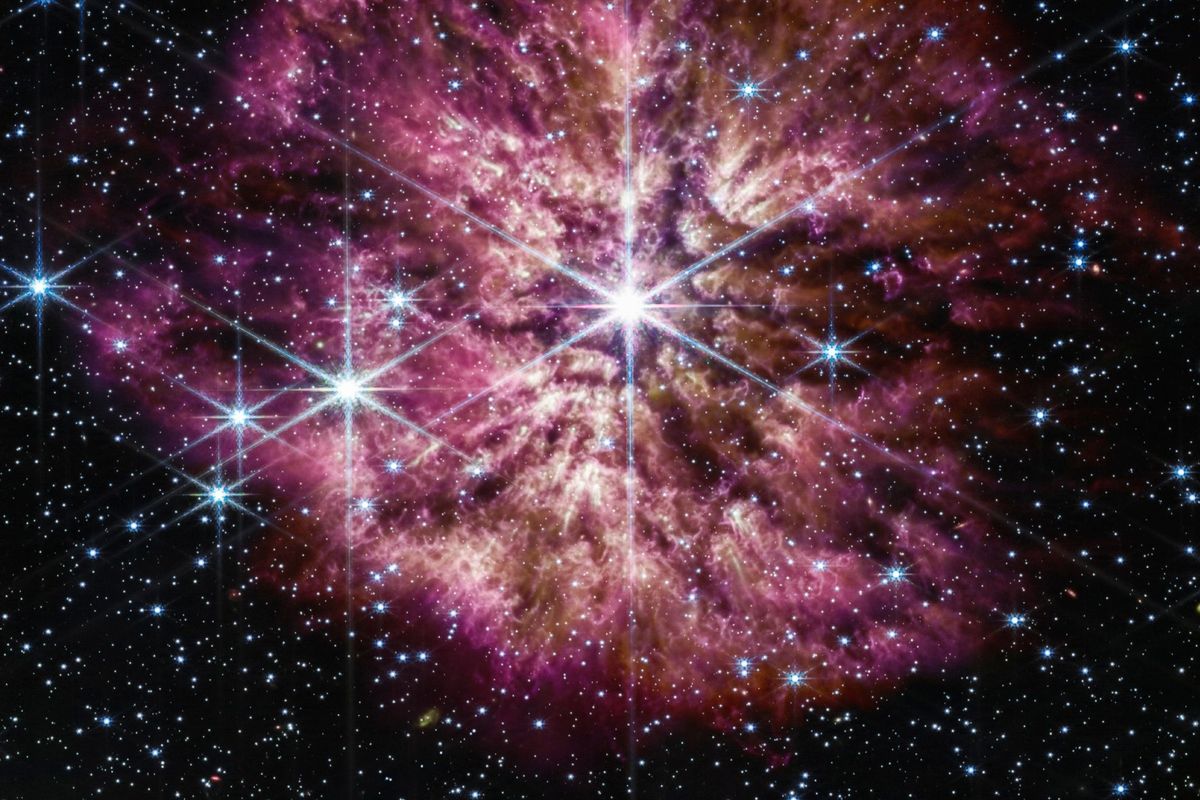
How Stellar Death Diverges
A star’s ending begins with a contest between gravity and pressure made by hot, nuclear-burning gas. The winner depends on the star’s starting mass, the mass it loses, its chemical makeup, rotation, and any companion orbiting nearby. A star born with roughly eight or more solar masses commonly reaches an iron core and may die in a core-collapse supernova. A Sun-like star never reaches that stage: it expels its outer layers and leaves a compact carbon-oxygen white dwarf that radiates stored heat for billions of years.
These are not two versions of the same event. Core collapse can shrink a roughly 5,000-mile-wide core to a neutron-star scale of about a dozen miles in seconds, according to NASA. A thermonuclear Type Ia event can instead destroy a white dwarf after runaway carbon burning. In the Milky Way, supernovas are rare, with estimates of roughly one every few decades for all major channels; a single event can briefly rival the light of a galaxy.
The phrase “simply cool off” also needs care. A white dwarf is not cold at birth. It is a star-sized remnant supported by electron pressure, with no sustained core fusion. Its surface gradually dims, while its interior changes from a hot fluid into a crystallizing solid. The universe is not old enough for a true black dwarf to have formed.
What Determines The Outcome
Birth mass sets the first broad route, but it does not act alone. A star near the lower edge of the massive-star range can lose enough material through winds or a companion interaction to finish with a smaller core. A heavier star may shed its hydrogen envelope and later appear as a stripped-star explosion. Consequently, the mass seen before death may differ sharply from the mass that shaped its core.
Core composition matters because fusion does not yield net energy once an iron-rich core forms. Earlier stages can fuse hydrogen into helium, helium into carbon and oxygen, and progressively heavier fuels in hotter layers. Iron-group nuclei do not give the core a useful pressure source through ordinary fusion. Gravity then drives collapse, electron captures change the composition, and a shock emerges from the forming compact remnant.
Binary systems add another route. A white dwarf can receive gas from a companion, or two white dwarfs can spiral together after losing orbital energy. A small surface flare, called a nova, ejects accreted material and does not normally destroy the dwarf. A Type Ia supernova is a far deeper runaway involving carbon and oxygen in the degenerate star. Confusing novae with supernovas makes the mass story sound simpler than it is.
How To Read The Evidence
Start With Initial Mass
Use initial mass as a guide, not a verdict. Stars below about eight solar masses generally avoid iron-core collapse and end as white dwarfs after a red-giant and asymptotic-giant phase. The Sun, at one solar mass, is the familiar example. Its distant future includes a swollen giant phase, envelope loss, and a cooling remnant rather than a blast.
Stars above that rough boundary burn fuel faster and build heavier cores. The number is not a sharp universal switch: metallicity, rotation, convection, and binary mass transfer shift the boundary. Models also distinguish an initial mass from a final core mass. When reading a claim about “an eight-Sun-mass star,” check which mass the author means and whether the system evolved alone.
Track The Core
The core supplies the decisive clue. A carbon-oxygen core below the pressure limit for collapse can become a white dwarf. A core that proceeds through advanced burning can accumulate iron-group material and lose its ability to support itself through fusion. Collapse then produces a neutron star in many cases, although a black hole can form when the remnant and fallback are heavy enough.
For a white dwarf, electron degeneracy pressure resists gravity without relying on heat in the same way ordinary gas pressure does. That support has a ceiling near 1.4 solar masses for a cold, nonrotating carbon-oxygen dwarf, the Chandrasekhar limit. The real explosion path depends on density, composition, accretion, rotation, and ignition geometry, so the limit is a useful physical scale rather than a promise that every dwarf reaching it explodes.
Check For A Companion
Look for signs that another star altered the life story. A companion may donate hydrogen or helium, strip an envelope, merge cores, or change the orbit until two compact remnants collide. Spectra showing hydrogen, helium, or neither help classify the visible debris, but those labels describe observed lines rather than a complete birth history.
In practice, astronomers compare a supernova’s light curve with its spectrum, search archival images for a progenitor, and inspect the remnant’s neighborhood. A hydrogen-rich Type II event points toward a core-collapse star that retained much of its envelope. A hydrogen-poor Type Ib or Ic event may indicate stripping. A Type Ia spectrum usually points to a thermonuclear white-dwarf channel, though several progenitor paths remain under study.
Use The Remnant
The aftermath can settle questions that the flash alone cannot. A pulsar or young neutron star supports a core-collapse interpretation. A black-hole candidate, expanding shock-heated gas, and freshly made elements also point toward a massive progenitor. Type Ia remnants lack a surviving central white dwarf in the usual full-disruption picture, but a companion star may remain and can be difficult to identify.
Timing adds another layer. The Crab Nebula’s supernova was recorded in 1054, and its central pulsar now gives a direct example of a compact remnant. For distant events, X-ray and radio observations may reveal shocks as ejecta hit circumstellar gas. The exact combination of lines, light-curve shape, neutrinos, and remnant geometry is more reliable than one headline classification.
Two Paths In Practice
Consider two anonymized stars born in the same stellar nursery. Star A begins near one solar mass. After roughly ten billion years on its main sequence, it swells, loses its outer layers through winds and pulsations, and leaves a hot white dwarf. No core-collapse shock appears. Its brightness falls over time, although the remnant can stay visible for an enormous span.
Star B begins at ten solar masses. It consumes fuel much faster, develops layered burning shells, and eventually builds an iron-rich core. Once the core cannot support its weight, collapse occurs in seconds. The outer layers are expelled, the spectrum reveals the material present, and a neutron star or black hole may remain. The two stars began with the same ingredients but used them at different rates.
A third scenario shows why binaries complicate the picture. A carbon-oxygen white dwarf receives matter from an evolved companion. If conditions trigger runaway carbon fusion, the dwarf may be disrupted as a Type Ia supernova. The companion channel is not the same as a massive star’s iron-core collapse, and two white dwarfs can reach a similar observational class through a merger. Astronomers therefore test several histories against the data.
Fate Comparison Checklist
| Clue | Quiet Ending | Core Collapse | Thermonuclear Blast |
|---|---|---|---|
| Typical starting route | Low or intermediate mass | High mass, altered by mass loss | White dwarf in a binary path |
| Energy source | Stored heat escaping | Gravitational collapse | Runaway nuclear burning |
| Likely remnant | White dwarf | Neutron star or black hole | Usually no intact dwarf |
| Best first question | Did fusion stop before iron? | What core and envelope survived? | Was a compact binary involved? |
Use the checklist as a sequence: estimate the initial mass, reconstruct mass loss, identify the core, inspect binary evidence, then compare spectra and remnants. A single clue can mislead. For example, missing hydrogen may reflect envelope stripping rather than a thermonuclear origin, while a bright outburst may be a nova instead of a supernova.
Common Reasoning Errors
The first error is treating mass as a simple switch. Initial mass predicts broad behavior, yet binary exchange can move a star across evolutionary tracks. The second is calling every brilliant outburst a supernova. Novae brighten when surface hydrogen burns on a white dwarf; the dwarf normally survives. The third is assuming that a white dwarf is already cold. It begins hot and gradually loses internal heat.
Another error is treating Type I and Type II as pure physical categories. The original labels came from spectral lines, especially hydrogen, so stripped massive stars can appear in Type I subclasses. A reader should pair the label with the proposed progenitor and the remnant evidence. Finally, avoid treating the Chandrasekhar number as an automatic trigger. Composition and ignition conditions decide what happens near that mass.
FAQ
Why does the Sun not explode?
The Sun lacks enough initial mass to build an iron core. It will lose its outer layers and leave a cooling white dwarf after its giant phases.
What mass usually leads to a supernova?
About eight solar masses is a common lower estimate for stars that can reach core collapse, but mass loss and binary evolution shift the boundary.
Can a white dwarf explode?
Yes. Accretion or a merger can trigger runaway nuclear burning, producing a thermonuclear supernova in some binary systems.
Does every massive star leave a neutron star?
No. Core mass, fallback, and the collapse engine affect the result; some massive-star deaths may leave black holes instead.
How do astronomers tell the paths apart?
They combine spectra, light curves, neutrino or high-energy signals, archival progenitor images, surrounding gas, and the compact remnant.
Author's Insight
The cleanest lesson is that stellar death records the history of a core, not just the birth label on a star.
Mass starts the forecast, while fuel sequence, envelope loss, and companionship revise it.
Supernovas look like sudden endings, but their observable signatures preserve stages that unfolded millions or billions of years earlier.
That is why astronomers compare several independent clues before assigning a progenitor channel.
Key Takeaways
Low- and intermediate-mass stars usually finish as white dwarfs that cool and fade. High-mass stars can build iron cores and collapse, producing a supernova and often a neutron star or black hole. A separate thermonuclear route begins with a white dwarf in a binary system. Initial mass is a useful starting point, yet mass loss, composition, rotation, and companions can change the route. The safest interpretation joins the star’s spectrum to its light curve, surroundings, and remnant.