The First Eight Minutes
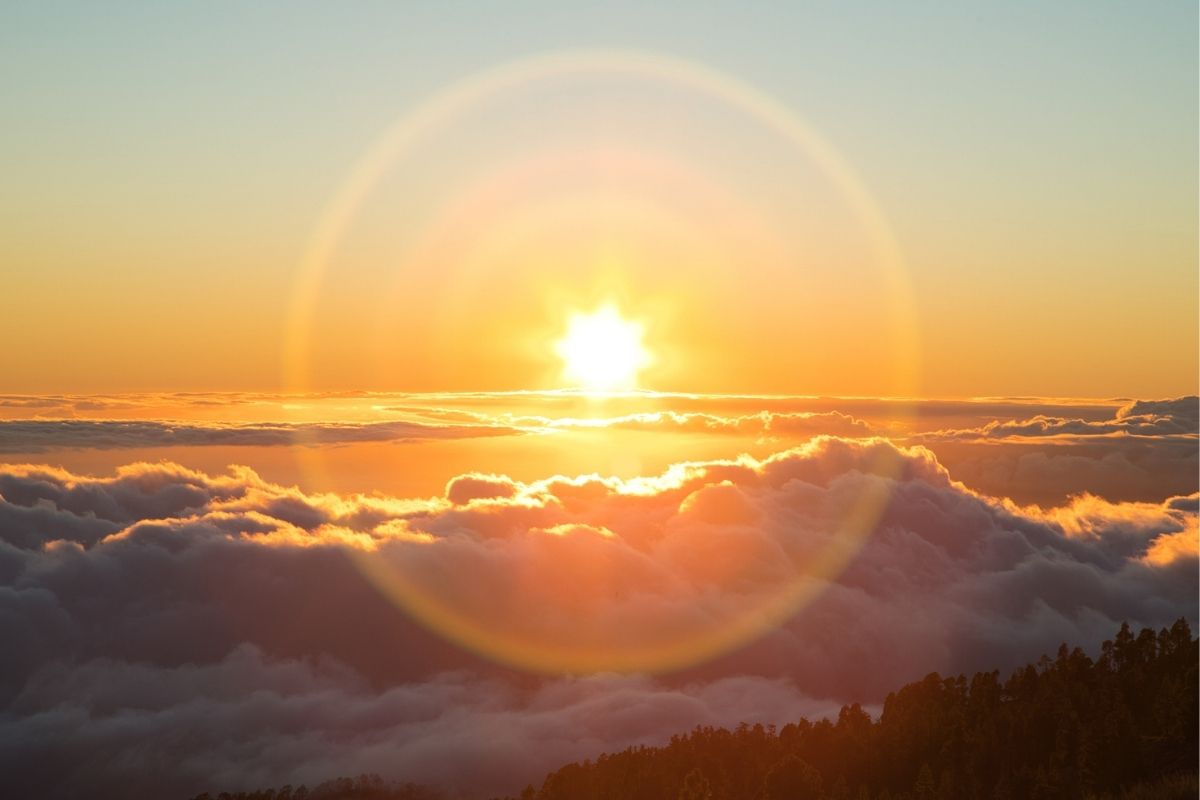
If the Sun vanished at noon, Earth would not react at that instant. Sunlight already traveling through space would continue arriving for about 8 minutes 20 seconds, the time light needs to cross the average 150 million kilometers between the Sun and Earth. During that short interval, daylight, solar heating, and the Sun's apparent disk would look normal. The change would reach us as a missing signal, not as a visible warning.
The thought experiment needs one clear assumption: the Sun's mass and its radiation disappear together. NASA measures the total solar irradiance near Earth's orbit at about 1,361 watts per square meter on a surface facing the Sun, with a much smaller variation across the roughly 11-year solar cycle. Remove that input and Earth's energy budget immediately loses its main external source, but the planet still contains stored heat.
Gravity changes would also travel outward at the speed of light in general relativity. Once the last sunlight passed, Earth would no longer follow its present orbit around the Sun. It would move along a path close to the tangent of its former orbit, continuing through interstellar space at about 30 kilometers per second. The Moon would remain bound to Earth because Earth's gravity would still exist.
Darkness And Lost Energy
The first visible effect would be abrupt darkness across the day side, followed by an ordinary night on the other half of the planet. Artificial lights would still work while fuel, batteries, grids, and generators lasted. The atmosphere would not vanish, and Earth's rotation would not stop. Darkness matters because no replacement source can match the Sun's steady input across the whole surface.
Photosynthesis would stop as soon as usable sunlight ended. Plants would not all die at once: leaves, roots, seeds, fungi, and stored food differ greatly in their reserves and cold tolerance. Most crops, grasses, and algae would stop growing, so food chains would begin losing their primary energy source. Animals could survive for a time by eating stored biomass, but that is a transfer of existing chemical energy, not new production.
Weather would continue briefly because air and water already hold heat. Winds would not switch off like a lamp; pressure differences, rotation, storms, and evaporation would keep moving the atmosphere. As the surface cooled, those gradients would change. Clouds could persist while the air remained moist, and precipitation could continue from stored atmospheric water, though the global hydrological cycle would weaken rapidly.
Land would cool faster than ocean because rock and soil have less heat capacity than the upper sea and do not mix heat downward in the same way. Clear skies could speed radiative loss from some regions, while clouds would temporarily slow it. Snow and ice would expand reflective surfaces, but reflectivity would no longer matter much once incoming sunlight reached zero.
The atmosphere would lose heat from below and eventually from contact with a colder surface. Water vapor would condense and freeze, reducing one of the atmosphere's strongest natural heat-trapping components. Carbon dioxide would remain gaseous far longer than water, although a very cold atmosphere could eventually deposit some carbon dioxide as frost near the surface. The order and timing would vary by altitude, latitude, clouds, and local geography.
There is no single exact temperature for every place or every date. Earth's heat capacity, ocean mixing, ice cover, geothermal activity, and atmospheric composition create different paths. A familiar day-night forecast would become useless, but the physical sequence is firm: no new sunlight, continued infrared radiation to space, falling surface temperature, weakening evaporation, and a progressive collapse of ordinary weather.
What To Do First
Protect Heat And Power
In the first hours, people would gain more from conserving usable energy than from chasing an explanation. Close insulated spaces, reduce unnecessary electrical loads, and use safe heat sources with ventilation. A building's warmth would depend on its insulation, size, occupancy, and fuel supply; there is no universal countdown. Backup generators would work only while fuel and maintenance remained available, and indoor combustion could cause carbon-monoxide poisoning.
Hospitals, water plants, communications centers, and food warehouses would need priority power. Batteries and solar panels would cease receiving new solar energy, but batteries could still run equipment. Nuclear, hydroelectric, geothermal, and chemical-fuel systems would not rely on current sunlight in the same way, though each would face cooling, staffing, supply, or mechanical limits.
Manage Food And Water
Eat perishable food first when refrigeration becomes uncertain, then shift to durable stores. Keep drinking water protected from freezing and contamination; pipes can burst as water expands, even before outdoor ice becomes permanent. Seed banks and greenhouses would not solve the energy deficit unless they had a non-solar power source and a controlled heat supply.
Food planners would track calories, protein, medicine, and animal feed instead of assuming that a single crop can carry a community. Indoor farms could grow for a while under electric lamps, but their output would be bounded by available power, nutrients, equipment, and replacement parts. A useful planning detail is that a lamp converts stored electricity into light; it does not create food energy from nothing.
Choose Sheltered Locations
Near-term shelter favors buildings below ground or in regions with reliable non-solar energy, insulation, water access, and trained operators. Deep mines, tunnels, and purpose-built facilities could retain heat better than exposed structures. They would still need air circulation, waste handling, fire control, medical care, and a way to replace failing pumps.
Geothermal regions could offer a continuing heat source because Earth's interior is not powered by the current sunlight. That does not make every hot spring safe: volcanic gases, unstable ground, contaminated water, and limited space create serious hazards. A site would need measurements and engineering checks rather than a label such as “warm place.”
Plan For Communication
Use low-power radios, written procedures, and local schedules while satellites and data centers remain functional. The first communication problem would be coordination across a frightened population, not a mysterious change in radio physics. Operators would need fuel inventories, spare parts, repeaters, and clear authority for rationing.
Record temperature, pressure, ice growth, water quality, and power use. A dated log turns a frightening global event into usable evidence for nearby decisions. Even an ordinary thermometer and a printed chart could matter after network services fail; the side observation sounds modest, but it separates measured change from rumor.
Two Realistic Scenarios
Consider a coastal city that loses the Sun during a winter morning. Its grid initially stays online, so residents see darkness but retain heat, lifts, refrigeration, and mobile service. The city opens heated public buildings, protects water mains, and rations fuel. Within days, falling temperatures and supply interruptions become harder than the first night, while the ocean moderates the coast compared with nearby inland districts.
Now consider a research station near a geothermal field. Its small population has drills, insulated rooms, a power source, and water treatment, yet it cannot replace all food production. The station may last longer than an ordinary town because heat and power are concentrated, but its survival depends on stockpiles, maintenance, disease control, and cooperation. Neither scenario supports a precise claim about a fixed survival time.
Timeline For Decision Making
| Period | Likely change | Main constraint | Useful response |
|---|---|---|---|
| 0–8 minutes | Normal daylight continues | No visible warning | No physical action is possible |
| Hours | Darkness and lost solar input | Power and information | Conserve heat, power, and water |
| Days to weeks | Cooling, crop failure, weaker weather cycle | Fuel and food logistics | Move people and supplies to sheltered hubs |
| Months onward | Persistent cold and expanding surface ice | Long-term heat and food production | Rely on interior heat and closed systems |
This timeline is a decision aid, not a weather forecast. Local elevation, season, ocean proximity, infrastructure, and geothermal heat would shift the pace. The table also shows why “Earth freezes instantly” is wrong: the planet radiates stored energy away over time, while the deep ocean and crust release heat slowly.
Common Mistakes To Avoid
The first mistake is treating the eight-minute light delay as eight minutes of safety after the Sun disappears. The delay describes information travel; once the final photons arrive, the surface has lost its energy source. The second mistake is assuming that darkness instantly stops gravity, rotation, air, or all electric power. Only the Sun's radiation and gravitational influence are removed under this scenario.
Another error is assigning one global temperature to one global date. A desert at high elevation, a tropical island, and a deep underground facility would not cool alike. Ocean water also does not freeze from the top to the bottom on one schedule. Salt, circulation, pressure, ice insulation, and heat from below affect the result.
Do not describe geothermal energy as an unlimited replacement. Earth's internal heat is diffuse, sites are unevenly distributed, and extracting it needs wells, pumps, materials, and expertise. Do not assume stored food alone solves the problem: sanitation, oxygen management, medicine, social order, and equipment failure would shape every long-term refuge.
FAQ
Would Earth leave its orbit immediately?
After the missing gravity signal reached Earth, the planet would travel roughly tangent to its former orbit instead of curving around the Sun. Its motion around its own axis would continue.
Would the Moon leave Earth too?
No. In this scenario the Moon would remain gravitationally bound to Earth because the Sun's disappearance does not remove Earth's mass or local gravity.
How fast would Earth become frozen?
There is no single worldwide timetable. Land and air would cool first, while oceans and the crust would release stored heat more slowly; surface ice would expand over time.
Could humans survive underground?
Some groups might last longer in insulated facilities with non-solar power, heat, water treatment, food stores, and maintenance capacity. A shelter alone would not solve oxygen, disease, waste, or equipment problems.
Would plants die instantly?
Photosynthesis would stop when sunlight ended, but plant death would vary with stored reserves, temperature, species, and access to artificial light. Seeds and roots could persist after leaves failed.
Author's Insight
The most useful lesson in this scenario is the difference between an energy shock and an instant erasure of every Earth system. Sunlight drives photosynthesis, evaporation, winds, and the surface climate, yet the ocean, atmosphere, crust, and human infrastructure store energy on different clocks. That separation explains why the first response concerns heat and logistics while the later response concerns closed habitats and interior heat. It also marks the boundary between firm physics and uncertain local forecasts: the sequence is defensible, but exact temperatures and dates require a detailed climate model.
Key Takeaways
Earth would remain physically intact if the Sun vanished, but its familiar surface life-support system would begin failing after the last sunlight arrived. Darkness would come after about 8 minutes 20 seconds; orbit, photosynthesis, evaporation, food production, and climate would then diverge on different timelines. Oceans and geothermal sources would slow cooling rather than restore the lost energy supply. The strongest practical advantages would belong to communities with insulation, non-solar power, protected water, durable food, measurement tools, and cooperative maintenance. The scenario is extreme, but it clarifies how much everyday life depends on one continuous stellar input.