Voyager 1 Journey
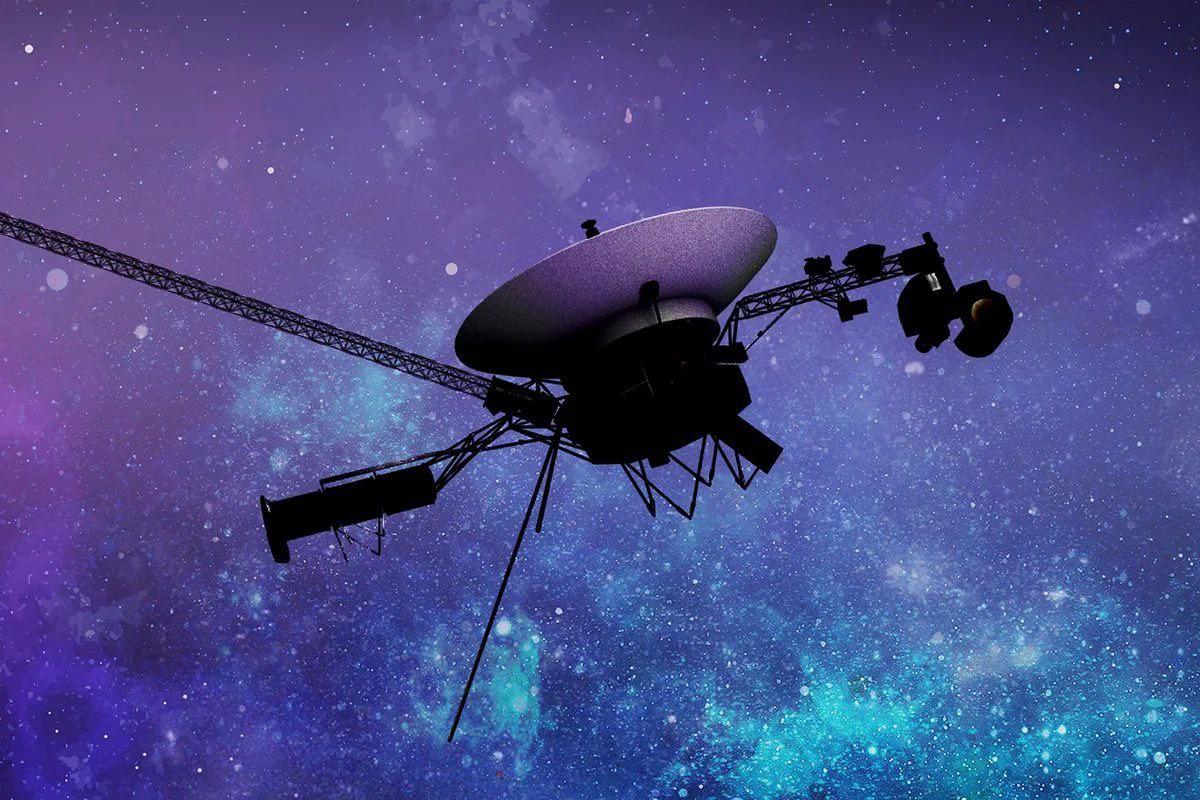
Voyager 1 left Earth on September 5, 1977, on a fast route toward Jupiter and Saturn. Gravity from those planets bent and increased its path, sending the probe above the plane where most planets orbit. It passed Jupiter in 1979 and Saturn in 1980, then continued outward instead of circling back. NASA describes it as the first human-made object to enter interstellar space.
The boundary in question is the heliopause, where the Sun's outward flow of charged particles yields to the surrounding interstellar medium. Voyager 1 crossed it on August 25, 2012, after passing through the termination shock in December 2004 and the heliosheath. Its speed is about 3.5 astronomical units per year; one astronomical unit, or AU, is the average Earth-Sun distance, about 150 million kilometers.
Distance alone does not make the probe scientifically unusual. It is still a working measuring station, traveling through a region no other spacecraft has sampled directly. NASA's April 17, 2026 report states that two science instruments remain operating: the magnetometer and the plasma wave subsystem. Its final image set, made in 1990 from roughly 40 AU, was taken before its cameras were switched off.
“Most isolated” is a useful description, not a formal scientific category. Other probes are also leaving the Sun's neighborhood, including Voyager 2, Pioneer 10, Pioneer 11, and New Horizons. Voyager 1 remains the most distant human-made object, and its separation from Earth keeps growing by roughly 3.5 AU each year.
Why Isolation Is Difficult
A common mistake is to treat the edge of the solar system as a solid wall. The heliopause is a shifting boundary in plasma and magnetic fields, not a visible shell. Solar activity changes the pressure of the solar wind, so its position varies. Crossing it means that instruments detected a change in the surrounding particle environment, not that the probe entered a region with no solar influence.
A second error confuses distance from Earth with distance from the Sun. Both numbers are close at Voyager's range, yet they answer different questions because Earth moves around the Sun. Mission teams use astronomical units, kilometers, light-hours, and signal delay to describe the separation. A radio command needs more than 23 hours to reach Voyager 1 at its present distance, and a reply takes the same time to return.
People also read silence into weak data. The craft does not stream video or send a live conversation. Its X-band downlink can reach rates as high as 7.2 kilobits per second, while the older S-band channel carries only low-rate engineering information. Ground antennas must find a faint carrier, decode a small data flow, and distinguish spacecraft behavior from noise.
Finally, the probe's age creates a moving target. Radioisotope generators lose output as plutonium-238 decays, and each operational year brings a smaller power margin. A sensor being switched off does not mean the whole mission ended; it means engineers chose the measurements that fit the remaining electrical and thermal budget.
How To Track The Probe
Start With The Right Units
Use AU for a compact measure of heliocentric distance and kilometers for engineering scale. An AU is about 150 million kilometers, so a statement such as “Voyager is 165 AU away” means a separation near 25 billion kilometers, not 165 kilometers or 165 light-years. Light-time is a second useful measure: radio waves travel at light speed, making a one-way delay of about 23 hours a practical reminder of the distance.
For a reliable check, write down the reference point, the date, and the unit. NASA's Voyager FAQ gives an outward rate of about 3.5 AU per year, but a live position changes continuously and Earth’s orbit affects the Earth-spacecraft figure. Round numbers work for explanation; a mission log should retain its timestamp and stated source.
Read Boundary Evidence Carefully
Interstellar space is identified through several measurements rather than a photograph. Voyager 1 observed a sharp fall in solar-wind particles, a rise in galactic cosmic rays, and a magnetic-field change around the 2012 crossing. The plasma instrument itself had stopped working after the Saturn encounter, so researchers also used plasma-wave observations to estimate the density of the surrounding medium.
These signals describe a transition zone. The heliopause separates the solar wind's dominant particle flow from the interstellar medium, while the heliosheath lies between the termination shock and that boundary. A chart that labels the heliopause as the end of every solar influence oversimplifies the evidence.
Check The Communication Chain
Voyager's high-gain antenna must remain pointed toward Earth, and the Deep Space Network receives its very weak signal through large ground antennas. The chain has several stages: a command is encoded and transmitted, the spacecraft's receiver accepts it after the light-time delay, onboard systems execute it, and telemetry travels back for confirmation.
Readers can interpret a mission update by separating command time from event time. If engineers send a shutdown instruction on a Monday, the probe will not receive it until the following day at this distance. The resulting telemetry arrives roughly another day later. That delay shapes every troubleshooting decision and makes gradual, conservative procedures safer than rapid experimentation.
Follow Power And Instrument Status
Each Voyager spacecraft draws electricity from three radioisotope thermoelectric generators. Heat from decaying plutonium-238 becomes electrical power, with no solar panels needed so far from the Sun. NASA reports that the generators lose about 4 watts per year, a small annual change that becomes decisive after nearly five decades.
Instrument status needs a date. The April 17, 2026 NASA report lists only two operating science instruments on Voyager 1: the magnetometer, which measures magnetic fields, and the plasma wave subsystem, which listens to waves associated with plasma. A careful reader should record the source date, name the instrument, and distinguish “active,” “collecting science,” “transmitting data,” and “still physically aboard.” Those labels do not mean the same thing.
Lessons From The Mission
One anonymized classroom scenario begins with a student who claims Voyager 1 has traveled beyond the entire galaxy because it is “in interstellar space.” The instructor places the heliopause, the nearest stars, and the Milky Way on separate scales. The correction is simple: the probe has left the Sun's heliosphere, yet it remains inside the Milky Way and has not approached another star. A scale drawing prevents a category error better than a dramatic distance headline.
In a second educational scenario, a reader compares two websites and finds 164.7 AU on one page and a different number on another. The figures may have different dates or reference points. Recording each page's update date and asking “from Earth or from the Sun?” resolves the apparent disagreement. The lesson applies to every live mission tracker: a changing position is not automatically a contradiction.
The mission also shows why a long-lived probe can outlast its original plan. Voyager 1 was designed for outer-planet flybys, but a functioning antenna, careful power management, and instruments suited to particle and field measurements extended the work. That extension did not turn the spacecraft into a modern observatory; its computers, memory, bandwidth, and sensors remain limited.
Distance Evidence Checklist
Use this checklist before repeating a claim about Voyager 1 or another distant probe:
- Identify the object and confirm that the claim concerns Voyager 1 rather than Voyager 2 or New Horizons.
- Record the date of the position or status statement.
- Check the reference point: Earth, the Sun, or a named planetary body.
- Convert AU only after noting that one AU is about 150 million kilometers.
- Separate heliopause crossing from escape from the Milky Way or arrival near another star.
- Read the instrument status and power notes on a current NASA mission page.
- Estimate communication delay before assuming an event was observed in real time.
- Use a primary source for dates, engineering figures, and discoveries.
The checklist favors traceable claims over false precision. A position with many decimal places may look authoritative while hiding an old timestamp. A rounded value with a date and source can be more useful for a general reader.
| Claim | Best measure | Evidence to check | Common confusion |
|---|---|---|---|
| Farthest object | Distance and date | NASA mission position | Live versus dated value |
| Interstellar entry | Particle and field changes | Heliopause analysis | A solid outer wall |
| Still working | Instrument and power status | Current mission bulletin | Every sensor still active |
Common Voyager Mistakes
Do not call Voyager 1 the first object to leave the solar system without defining the phrase. NASA uses interstellar space here to mean the region beyond the heliosphere. The Oort Cloud, a distant population of icy bodies inferred from comet orbits, extends much farther and is not the same boundary.
Do not say that the probe is heading toward a nearby star as if it has a planned rendezvous. Voyager 1 is on an escape trajectory, and a future stellar pass would occur at an enormous distance and timescale. “Beyond” describes its direction and environment, not a scheduled destination.
Do not treat the Golden Record as a broadcast. It is a 12-inch gold-plated copper phonograph disk with 115 images, natural sounds, music, and greetings in 55 languages. The spacecraft carries it as a physical message for a hypothetical finder; its radio transmissions are mission telemetry, not an intentional conversation with aliens.
Do not copy a live-looking number without its date. Mission pages are updated, and the probe's distance changes every day. Do not infer that an instrument is dead from one missing data stream, either; check the named subsystem and the latest status notice.
Do not describe the probe as self-sufficient. Commands, navigation support, tracking, data processing, and power decisions still depend on Earth-based teams and the Deep Space Network. Its endurance reflects careful operations, not an absence of maintenance.
FAQ
How far away is Voyager 1?
Its distance changes continuously, so use a dated NASA position and note whether the figure is measured from Earth or the Sun; the probe moves outward at about 3.5 AU per year.
Did Voyager 1 leave the solar system?
It crossed the heliopause on August 25, 2012 and entered interstellar space, but that does not mean it left the Milky Way or passed beyond every object gravitationally linked to the Sun.
Can Voyager 1 still communicate?
Yes, its high-gain antenna can still exchange weak radio signals with NASA's Deep Space Network, although the round-trip delay is more than 46 hours at its great distance.
What is Voyager 1 carrying?
It carries the Golden Record, a 12-inch gold-plated copper disk containing selected images, Earth sounds, music, and greetings intended as a physical message for a possible future finder.
Will Voyager 1 reach another star?
It has no planned star rendezvous; it will continue on an escape path through interstellar space, passing any future star at a very large distance.
Author's Insight
Voyager 1's isolation is best understood as a measurement problem, not a loneliness metaphor. Its record matters because instruments turned a remote boundary into evidence about particles, fields, and plasma. The mission's greatest operational lesson is that distance multiplies every delay, uncertainty, and power decision. A dated source and a clearly defined boundary make the story more accurate without making it less remarkable.
Key Takeaways
Voyager 1 is the most distant human-made object and the first to sample interstellar space beyond the heliopause. Launched in 1977, it reached that boundary in 2012 and continues a slow outward journey at roughly 3.5 AU per year. To follow its progress, distinguish Earth distance from Sun distance, use dated NASA status pages, and treat instrument and power lists as changeable. As of NASA's April 17, 2026 report, only the magnetometer and plasma wave subsystem remain operating for science. The probe is not heading for a nearby star, and the Golden Record is a physical time capsule rather than a live message. Its fading power and long signal delay set real limits on the science still possible.