What Mirror Recognition Means
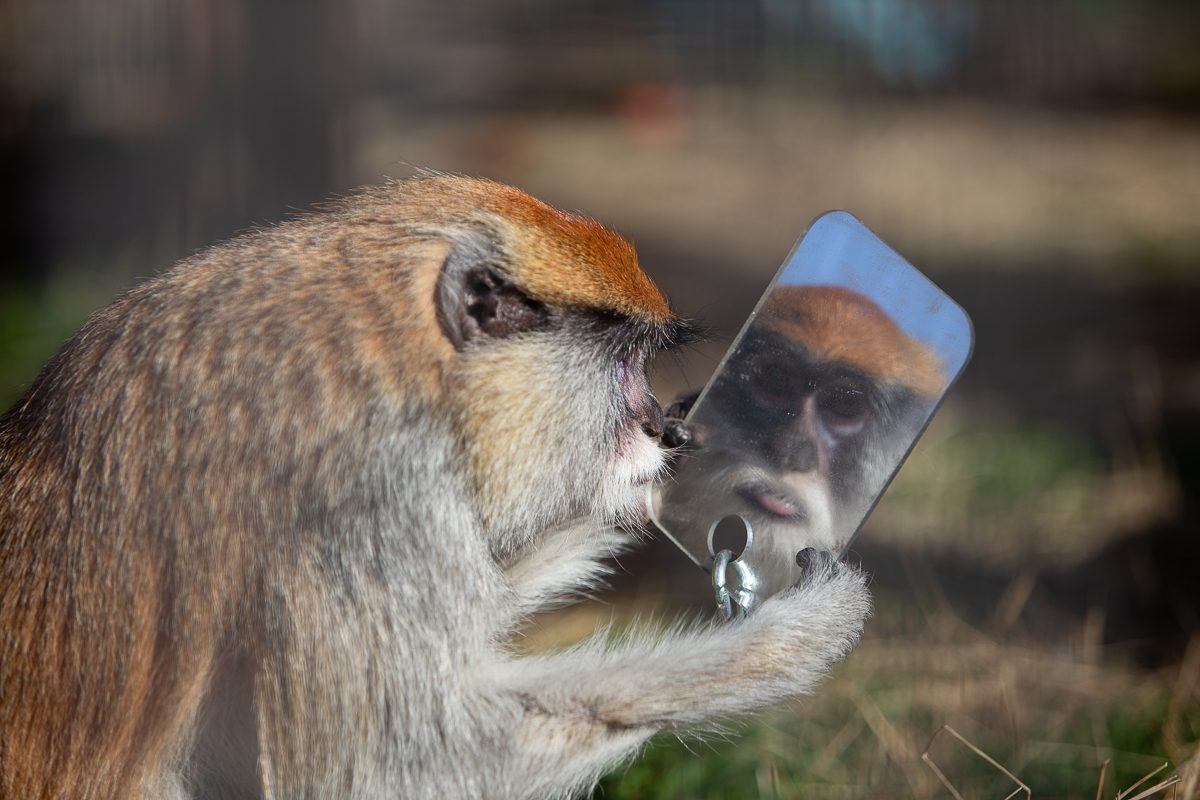
A mirror shows an animal a moving image that matches its own body. At first, a subject may treat that image as a rival, mate, or unfamiliar visitor. Researchers look for a change: the animal uses the reflection to inspect or touch a part of its body that it cannot see directly. This behavior is called mirror self-recognition, or MSR.
Gordon Gallup's 1970 chimpanzee study introduced the modern mark test. After animals had time with a mirror, researchers placed a visible mark where it could be seen only in reflection. A subject that used the mirror to investigate the mark showed evidence that it linked the reflected body with its own body. That conclusion is narrower than saying the animal has a human sense of self.
Great apes, bottlenose dolphins, and Asian elephants have produced the clearest evidence; the early Eurasian magpie result is disputed after a close 2020 replication failed to confirm it. In 2008, a PLOS Biology study reported mark-directed behavior in magpies, a bird lineage with a very different brain structure from mammals. Cleaner wrasse produced a striking result in a 2019 study, but later discussion shows why a single test needs careful interpretation.
Why The Test Is Difficult
A mirror test depends on vision, motivation, body access, and a subject's willingness to interact. An animal that relies on smell or sound may understand its body without using a reflective surface. A mark on fur, feathers, scales, or skin may feel irritating, disappear during grooming, or sit where the animal cannot reach it.
Researchers must separate self-directed behavior from ordinary grooming. They also need to distinguish recognition from social interest. A chimpanzee may inspect its mouth because the reflection gives useful visual feedback; a bird may peck at a mirror because it sees a competitor. Neither response alone settles the question.
Training creates another problem. If an animal learns to touch a mark after repeated prompting, the result may show task learning rather than spontaneous recognition. Familiarity matters too. A captive animal may have seen glass or polished surfaces before, while a wild subject may react to a mirror as an unusual object. Ethical work therefore uses short sessions, non-harmful marks, and controls that do not depend on distress.
How Researchers Test
Start With A Mirror Baseline
Researchers first record what happens when the mirror is introduced without a mark. They may code approach, retreat, threat displays, inspection of hidden body areas, and repeated movements. A baseline can last several days or include multiple sessions; the exact schedule varies by species and study design. Early social reactions do not count as a pass.
Contingency checking is a useful clue. An animal may make an unusual movement and watch whether the reflection copies it at the same time. It may move behind the mirror, look around its edge, or repeat a gesture from different positions. These actions suggest that the subject is learning the relation between its own movement and the image, yet they remain suggestive rather than decisive.
Use A Hidden Mark
The mark should be visible in the reflection but difficult or impossible to see without it. Researchers often place it on the face, throat, or another reachable area after the baseline period. The key observation is spontaneous mark-directed behavior: the subject looks in the mirror and then touches or examines the marked location on its own body.
A good design records latency, number of touches, viewing time, and the same behavior in an unmarked condition. One study might use a tiny sticker; another might use a harmless colored gel. Those details matter because the mark must be noticeable without changing the animal's comfort or movement.
Add Sham And No-Mirror Controls
A visible mark needs a comparison. A sham mark can match the feel and smell of the real mark while blending into the body surface. A no-mirror condition shows whether the animal touches the spot without visual feedback. These controls reduce the chance that researchers mistake an itch, odor, or random grooming bout for recognition.
Magpie research illustrates the value of this approach. A visible throat mark stood out in the reflection, while the sham mark did not. The birds scratched toward the visible mark more often when a mirror was present. The finding became stronger because the response depended on both the mark and the reflective view, though a close 2020 replication failed to confirm the earlier finding.
Interpret The Result Narrowly
A pass means that the behavior fits visual self-recognition under the study's conditions. It does not identify the animal's private thoughts, prove human-like introspection, or show that every member of the species will respond in the same way. Scientists should report individual results, sample size, controls, and study limits.
Replication matters because small samples can produce large headlines. Researchers can add self photographs, delayed video, body-part matching, or tests using sound and smell. Each method asks a different question. A mirror is one window into cognition, not a complete map of an animal's mind.
Evidence From Real Studies
Consider a captive Asian elephant given access to a large mirror. It first explored the surface and later used the reflection to inspect parts of its body. In the 2006 PNAS study, one elephant showed mark-directed behavior consistent with the test, while the small group also showed why individual data matter. The result strengthened the case for elephants without suggesting that all elephants must pass.
Now consider the 2008 magpie study. Five birds received marks on their throat feathers, with visible and sham conditions. Some birds used the mirror while scratching at the visible mark, and the authors reported the first evidence of mirror self-recognition in a non-mammalian species. A reader should describe this as evidence from tested magpies, not as a universal claim about birds.
Cleaner wrasse create a useful teaching scenario. In a 2019 PLOS Biology study, fish moved through aggressive responses, mirror-contingency behavior, and mark-directed scraping. The result challenged assumptions based on brain size, yet critics argued that scraping a mark resembling a parasite may reflect a learned cleaning response. The fair summary is that the study produced evidence consistent with MSR and a live debate about what the behavior means.
Species And Evidence Checklist
Use the checklist below when reading a claim about an animal that recognizes itself. It separates the observed behavior from the broader interpretation.
| Question | What To Check | Why It Matters | Cautious Reading |
|---|---|---|---|
| Baseline | Mirror behavior before marking | Shows social and exploratory reactions | A rival response is not self-recognition |
| Mark | Visible and hidden conditions | Tests visual feedback | Touching alone proves little |
| Controls | Sham mark and no-mirror trial | Rules out itch and odor | Look for matched comparisons |
| Replication | Individuals, sessions, and methods | Tests repeatability | One study is a starting point |
Common Testing Mistakes
The first mistake is calling any mirror interaction recognition. Threats, courtship, pecking, and repeated posing can all happen before an animal understands the image. A report should name the exact behavior and its control condition.
The second mistake is treating failure as proof of no self-concept. A dog may rely more on smell than sight. An elephant may not notice a small mark. A bird may be unable to reach the marked area. A negative result often says that the subject did not pass this visual task at that time.
The third mistake is ignoring sample size and individual variation. A headline may refer to two successful subjects in a group of six. Read the methods and results, not only the abstract. Dates, species names, mark placement, and session counts can change the meaning of a finding.
The fourth mistake is using brain size as a shortcut. Magpies and cleaner wrasse show why similar behavior can emerge in different bodies. Brain structure still matters for explaining mechanisms, but it does not replace behavioral evidence. Finally, avoid turning a test result into a welfare conclusion without supporting studies on pain, memory, social bonds, or preferences.
FAQ
Which animals pass the mirror test?
Clearer evidence comes from great apes, bottlenose dolphins, and Asian elephants. The 2008 magpie result was not confirmed by a close 2020 replication, so magpie and cleaner-wrasse findings remain disputed.
Does mirror recognition prove self-awareness?
No. It supports visual self-recognition under test conditions, while broader self-awareness includes abilities the mirror test does not measure.
Why do dogs usually fail the test?
Dogs depend heavily on smell, and a visual mark may not be a meaningful cue for them, so failure does not settle their wider self-knowledge.
What is the mark test?
Researchers place a hidden-from-direct-view mark on the animal and watch for unprompted inspection of that mark while using a mirror.
Can animals recognize themselves without a mirror?
Yes, animals may show body, voice, smell, or action-based self-knowledge, but those abilities require different experiments.
Author's Insight
The strongest mirror studies are persuasive because they combine a surprising action with careful controls. The most useful conclusion is modest: some animals can use visual feedback to identify a feature of their own body. That capacity may connect with social cognition, body awareness, or problem solving, but the connection needs separate evidence. Comparing species works best when researchers respect sensory differences instead of ranking minds on one human-designed task.
Key Takeaways
Mirror self-recognition is a behavioral finding, not a direct reading of consciousness. Great apes, dolphins, and elephants have the clearest evidence; magpie findings are disputed after a 2020 replication failed to confirm the earlier result, while cleaner wrasse remain a productive case for debate. Look for a baseline, hidden and sham marks, no-mirror controls, individual results, and replication. A failed mirror test can reflect sensory or physical limits. Read each result as one carefully bounded clue about how an animal experiences its body and surroundings.