Why The Moon Changes
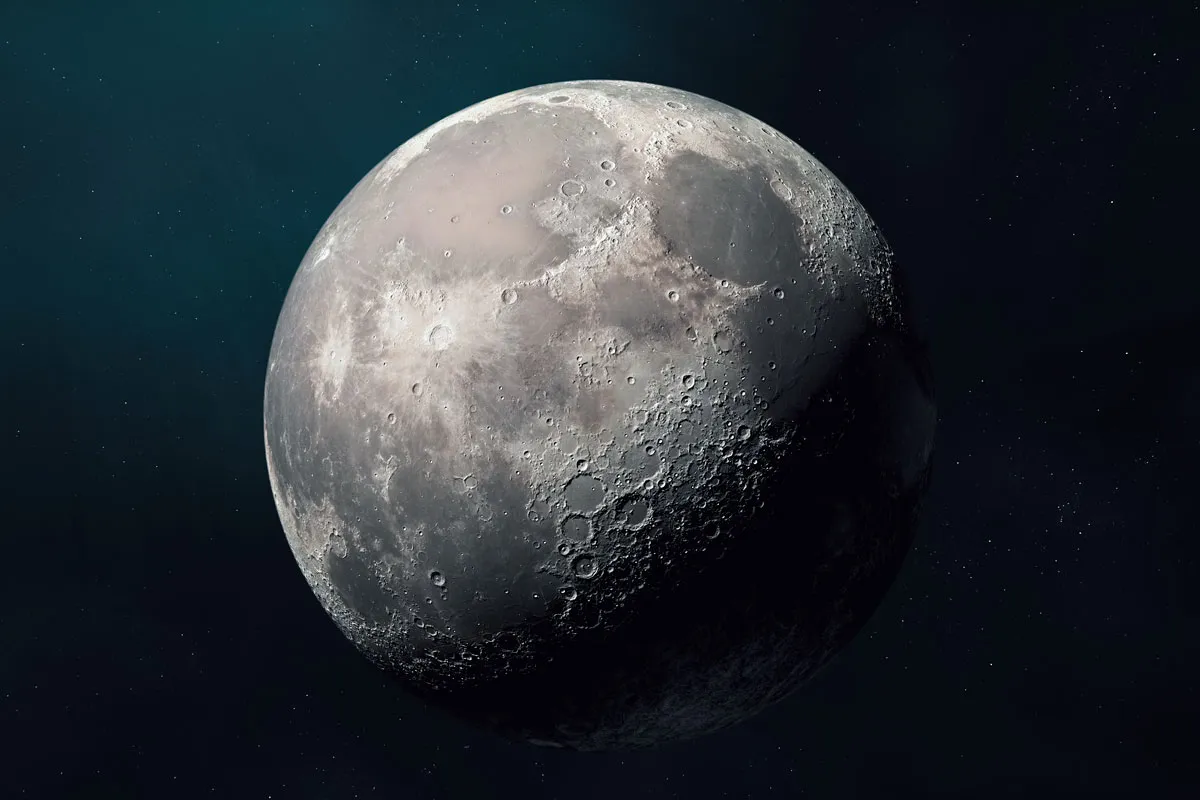
The phrase shrinking Moon describes a physical contraction of the lunar interior, not a visible reduction in the disk seen from a backyard. As the Moon loses internal heat, parts of its rock cool and occupy slightly less volume. The crust responds by crumpling along thrust faults, leaving curved cliffs called lobate scarps. NASA images show thousands of these features across the surface, many only tens of meters high but extending for kilometers.
A second change affects the Moon's orbit. Earth and Moon exchange angular momentum through ocean tides and the solid planet's deformation. Laser ranging to reflectors left by Apollo crews measures an average recession of about 3.8 centimeters, or 1.5 inches, per year. That outward motion is slow: in 250 years it adds roughly 9.5 meters, a tiny shift against an average Earth-Moon distance of about 384,400 kilometers.
These processes have different causes and evidence. Cooling contracts the Moon's body; tidal friction transfers rotational energy from Earth into the Moon's orbit. The two effects can interact through stress, but neither means the Moon is about to disappear. The rate also changes with ocean basins, ice, sea level, and the evolving Earth-Moon system, so a simple multiplication of today's rate cannot describe the full future.
What Causes The Drift
The Moon's gravity raises two broad tidal bulges in Earth's oceans. Earth rotates once in about 24 hours, faster than the Moon completes its roughly 27.3-day sidereal orbit. Because the ocean response is not perfectly aligned with the Moon, the nearer bulge sits a little ahead of the lunar position. Its gravity pulls the Moon forward along its path, adding orbital energy and pushing the satellite into a wider orbit.
Energy is not created in this exchange. Friction in oceans and within Earth's crust converts some of Earth's spin energy into heat. The planet's rotation therefore slows by a tiny amount, while the Moon's orbital distance grows. Modern laser ranging detects this change by timing the return of light from lunar retroreflectors. The experiment measures distance directly rather than inferring the result from the Moon's apparent size.
Several common interpretations go wrong. The Moon does not drift because gravity is weakening, and it is not escaping on a straight line. Its path remains an orbit, with a wider average radius. Its distance also varies by about 43,000 kilometers during an orbit because the path is elliptical, far more than the yearly recession. That monthly variation can obscure the small long-term trend unless scientists use long records and precise models.
How To Read The Evidence
Use Laser Ranging
A lunar retroreflector sends incoming laser light back toward its source, and observatories record the round-trip travel time. Light covers nearly 300,000 kilometers per second, so tiny timing differences correspond to measurable changes in distance. Researchers combine observations from multiple stations and remove effects such as Earth's atmosphere, station motion, and the Moon's uneven gravity field.
Readers should treat 3.8 centimeters per year as a measured present-day average, not a permanent cosmic speed limit. Tidal dissipation varies because coastlines, ocean depth, ice sheets, and seafloor geometry change. A single year's reading is less useful than a multi-decade record. The same principle applies to ordinary graphs: a smooth trend can hide seasonal or instrumental variation.
Study Scarps And Faults
Lobate scarps form when the lunar crust is pushed together as the interior contracts. Their crisp appearance and small scale suggest many are geologically young, with some estimates placing them below 50 million years old. The Lunar Reconnaissance Orbiter Camera maps their locations, slopes, shadows, and relationships with impact craters, giving scientists clues about age and recent movement.
Image evidence does not mean every scarp moved yesterday. A fresh-looking surface can retain its shape for a long time because the Moon lacks rain, wind, and active plate recycling. Scientists compare terrain age, fault orientation, seismic records, and gravitational stresses before linking a feature to current activity. In practice, a 3-D terrain model is more informative than a dramatic single photograph.
Track Moonquakes Safely
Seismometers from the Apollo missions recorded shallow moonquakes between 1969 and 1977. Later analyses connected some events with faults that can slip as the crust contracts or responds to Earth's tidal pull. NASA reports that the Moon still experiences tectonic activity, although its quakes differ from familiar earthquakes because the dry, fractured interior transmits vibrations for a long time.
Future instruments could improve location estimates and reveal how often faults move. The practical lesson is modest: a map of a scarp marks a possible hazard for a lander, not a forecast of a specific quake. Mission planners can combine slope maps, boulder counts, seismic data, and repeat imaging to choose safer routes and instrument sites.
Separate Time Scales
Use centimeters per year for the orbital trend, meters or kilometers for surface structures, and millions of years for geological interpretation. Mixing those scales creates sensational claims. A 3.8-centimeter annual recession does not produce a noticeable naked-eye change from one year to the next, while a fault scarp several kilometers long records cumulative deformation over a far longer interval.
A useful worksheet has three columns: observation, mechanism, and time scale. “Laser distance increased” belongs with tidal energy transfer and decades of measurements. “Crustal cliff formed” belongs with cooling, contraction, and geological time. This small separation prevents a correct fact from being placed in the wrong explanation.
A Reader's Moon Scenario
Imagine an amateur astronomer comparing a 2026 photograph with one taken in 2025. The images show no reliable disk-size change because camera focus, atmospheric turbulence, phase angle, and Earth-Moon distance dominate the comparison. Even a perfect one-year measurement would involve only 3.8 centimeters against a lunar diameter of about 3,475 kilometers. The right conclusion is that visual observation is useful for phases and surface features, not for detecting annual recession.
Now consider a hypothetical lunar engineering team evaluating a site near a mapped scarp. The team would not label the whole Moon unstable. It would inspect local slope angles, loose regolith, nearby boulders, fault geometry, and seismic exposure, then place instruments away from steep ground. This scenario shows why contraction matters operationally: the risk is local ground movement, not the Moon leaving Earth's gravitational influence.
Compare The Main Clues
| Clue | What Changes | Main Mechanism | Best Evidence |
|---|---|---|---|
| Orbital recession | Average distance grows about 3.8 cm yearly | Tidal friction and angular momentum transfer | Laser ranging to reflectors |
| Interior contraction | Crust shortens along thrust faults | Cooling and loss of internal heat | Scarps, fault maps, and seismic records |
| Monthly distance cycle | Distance varies about 43,000 km | Elliptical orbit | Regular positional observations |
The table separates a measured long-term drift from short-term orbital geometry and surface geology. A source may mention all three, yet each answers a different question. For a clear explanation, match the evidence to the claim before drawing a conclusion.
Mistakes To Avoid
The first mistake is treating “shrinking” and “drifting” as synonyms. One describes a change in the Moon's interior and crust; the other describes the average orbit. Use separate headings, units, and mechanisms when writing or reading an explanation.
A second mistake is extrapolating 3.8 centimeters forever. Earth's tides have not always dissipated energy at today's rate, and the Sun will change the Earth-Moon environment long before a simple linear forecast becomes useful. State the measurement period and call it a current average.
A third mistake is using a photograph as proof of annual recession. Apparent size depends on distance, phase, optics, atmospheric conditions, and image processing. A fourth is treating every moonquake as a disaster warning. Shallow seismic activity deserves study, but a mapped fault does not identify the date or size of its next movement.
Finally, avoid presenting an eclipse forecast without orbital context. As the Moon recedes, its apparent diameter slowly decreases, while the Sun's apparent diameter also changes over very long stellar time scales. Predictions need a dynamical model, not a slogan about the Moon “escaping.”
FAQ
Is The Moon Really Shrinking?
Yes, its cooling interior contracts and compresses sections of the crust, forming lobate scarps; the change is geological and invisible without precise mapping.
How Fast Is The Moon Moving Away?
Laser ranging finds an average recession of about 3.8 centimeters, or 1.5 inches, per year, with the rate varying as Earth's tidal conditions change.
Will The Moon Escape Earth?
No. Tidal evolution changes the orbit gradually, and the Earth-Moon system will be altered by other processes long before the satellite could simply fly away.
Do Moonquakes Threaten Earth?
No. Moonquakes are lunar seismic events; they matter mainly for understanding the Moon and planning future surface missions.
Can I See The Moon Receding?
Not by eye or with ordinary yearly photographs. The effect is measured with laser reflectors and long records that separate the trend from monthly orbital distance changes.
Author's Insight
The most useful lesson is methodological: a familiar object can change in several ways at once, and each change needs its own measurement. Laser ranging turns a subtle orbital trend into a testable number, while orbital images and seismometers connect surface form with interior cooling. The evidence supports a Moon that remains active in a limited geological sense, not a world undergoing sudden collapse. For readers, the safest interpretation combines mechanism, scale, uncertainty, and time rather than relying on an alarming headline.
Key Takeaways
The Moon is slowly receding because Earth's tides transfer spin energy into lunar orbital motion, with a present average near 3.8 centimeters per year. It is also contracting as its interior cools, leaving thrust-fault scarps and contributing to shallow moonquakes. Neither process threatens Earth's orbit or signals an imminent departure. Use laser-ranging data for distance, spacecraft images for landforms, and seismic records for internal activity. The numbers become meaningful only when paired with the right time scale and a clear statement of their limits.