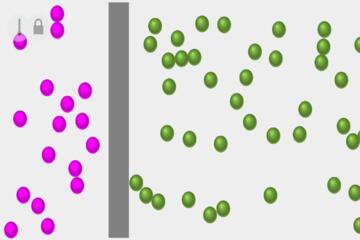
Quantum Tunneling And Barriers
Quantum tunneling describes a situation where a particle has a nonzero probability of appearing on the other side of a barrier even when classical mechanics predicts it cannot cross. The “barrier” is not a physical wall in the everyday sense; it is an energy region where the particle’s wave-like behavior does not match the allowed motion. In quantum mechanics, a particle is represented by a wavefunction, and that wavefunction extends into classically forbidden regions. The result is a measurable probability current on the far side, which is what experiments detect.
A practical example appears in semiconductor devices. In a typical MOSFET, electrons can tunnel through a thin insulating layer when the gate voltage makes the energy alignment favorable. The barrier thickness is on the order of a few nanometers in modern gate stacks, so tunneling probability becomes large enough to affect current. That is why device engineers treat tunneling as both a useful mechanism in some designs and a leakage problem in others.
Tunneling also shows up in nuclear physics. Alpha decay can be understood as an alpha particle escaping a potential barrier formed by the nuclear force and the Coulomb repulsion. The particle does not “climb out” in the classical sense; instead, its quantum state has a tail that penetrates the barrier region, and the decay rate reflects how often that tail leads to escape.
In scanning probe microscopy, tunneling is used in a different way. A conductive tip brought extremely close to a surface can measure current that depends exponentially on the tip-sample separation. That exponential dependence is a fingerprint of tunneling through a barrier shaped by the local electronic potential.
Common Misunderstandings And Dependencies
People often picture tunneling as a particle slipping through a hole in a barrier. Quantum tunneling does not require a literal gap; it relies on the wavefunction’s ability to penetrate a region where classical kinetic energy would be negative. Another common error is assuming tunneling probability depends only on barrier height. In reality, barrier width matters strongly, and small changes in thickness can produce large changes in tunneling rate.
Another misunderstanding treats tunneling as a magical exception to energy conservation. Energy conservation still holds in the sense that the particle’s total energy is accounted for in the quantum description. What changes is the classical rule about whether the particle can access a region of space with that energy. In quantum mechanics, the wavefunction can exist in the barrier region even when the classical momentum would be imaginary.
Tunneling depends on the particle’s effective mass in the material and on how the barrier is shaped. In semiconductors, the “barrier” is influenced by band structure, doping, temperature, and electric fields. Those factors determine whether electrons tunnel directly, via intermediate states, or through trap-assisted paths. If you ignore those dependencies, you can misread leakage currents as “mysterious tunneling” when they are actually dominated by a different transport mechanism.
Supporting technologies matter because tunneling is measured indirectly. In a MOSFET, you infer tunneling from current-voltage curves and temperature trends. In scanning tunneling microscopy, you infer local electronic structure from how current changes with distance. In alpha decay, you infer tunneling from decay lifetimes and branching ratios. Each measurement connects to a model with assumptions, and the assumptions vary by system.
One small aside: many textbooks use simplified one-dimensional barrier models. Those models are useful for intuition, but real devices have three-dimensional geometry, interfaces, and electric-field variations that shift the quantitative predictions. I once saw a lab group (firmware version 2.1.0 on their data acquisition system) fit a tunneling model to a curve and got a barrier height that disagreed with the device stack, which turned out to be a calibration offset rather than a physics failure.
How To Reason About Tunneling
Start With The Barrier Picture
Write down what “barrier” means in your context: an energy region where motion is classically forbidden, or an effective potential created by fields and material properties. For semiconductors, barrier height relates to band offsets and gate-induced energy alignment. For scanning probes, the barrier is tied to the work function and the local density of states. For nuclear decay, the barrier comes from the interplay of nuclear attraction and Coulomb repulsion.
Then identify the relevant particle and its effective mass. In solids, the effective mass can differ from the free-electron mass, which changes how quickly the wavefunction decays in the barrier. If you use a model with the wrong mass, the fitted parameters can look plausible while being physically misleading.
Use Width Sensitivity As A Reality Check
Tunneling probability changes rapidly with barrier width. This is why nanometer-scale thickness control matters in gate dielectrics and why leakage currents rise sharply as layers thin. A useful practical check is to compare measured current changes against expected exponential sensitivity. If the data changes only weakly with thickness or distance, the dominant mechanism may not be simple tunneling.
In scanning tunneling microscopy, the current typically varies roughly exponentially with tip-sample separation over a limited range. If you see a curve that does not match that trend, the tip condition, feedback loop settings, or contamination can dominate the measurement. A mild frustration here is that many people try to fit a single exponential across a wide range and then wonder why the fit fails.
Separate Tunneling From Other Transport
Not all “current through an insulator” is direct tunneling. In semiconductors, field emission, trap-assisted tunneling, and thermionic emission can all contribute depending on temperature and electric field. Trap-assisted tunneling often shows different temperature dependence than pure tunneling. Thermionic emission shows stronger temperature sensitivity because it relies on carriers having enough thermal energy to surmount part of the barrier.
To separate mechanisms, examine temperature sweeps and the shape of the current-voltage curve. Use models that include multiple terms rather than forcing a single mechanism to explain everything. If you only fit one regime, you can get a barrier parameter that matches that regime but fails elsewhere.
Connect Models To Measurable Quantities
Quantum tunneling is not a directly visible event; it is inferred from measurable currents, decay rates, or conductance. In electronics, you measure current and voltage and compare to tunneling-based transport equations. In scanning probes, you measure current at controlled distances and map it to local electronic properties. In nuclear physics, you measure half-lives and compare to decay models that include barrier penetration.
When you compare to a model, record the assumptions: dimensionality, barrier shape (rectangular vs triangular), and whether the model includes electric-field effects. A model that assumes a perfectly rectangular barrier can misestimate parameters when the actual barrier is sloped by an applied field.
Case Examples From Real Systems
Semiconductor Leakage In A Thin Oxide
An anonymized device team characterizes a MOSFET family where the gate oxide thickness is reduced to improve switching speed. They observe that off-state current rises as the oxide gets thinner, especially at higher gate voltages. A simple direct-tunneling model captures the trend in one voltage range, but at higher fields the temperature dependence changes, suggesting an additional contribution such as trap-assisted tunneling. The team then fits separate regimes and finds that the extracted “effective barrier” differs between regimes, which is consistent with a changing dominant mechanism rather than a single universal barrier.
They also check measurement artifacts: probe station leakage, guard ring behavior, and instrument offsets. In one run dated 2024-11-03, a recalibration of the current measurement range changed the fitted parameters enough to alter the conclusion about which mechanism dominated. The physics did not change; the measurement chain did.
Scanning Probe Imaging Of Local States
An anonymized lab uses scanning tunneling microscopy to image a surface with mixed chemical terminations. They set a target tunneling current and adjust tip height via feedback. The current-distance relationship shows an exponential trend over a narrow separation window, but the exponent shifts when the tip approaches a region with different local electronic states. The team interprets this as a change in the effective barrier and local density of states rather than a sudden “failure” of tunneling.
They avoid overfitting by using a short distance interval for the exponential fit and by verifying tip stability. When the feedback loop gain is too high, the tip can oscillate, producing current fluctuations that look like tunneling anomalies. After reducing the gain and repeating the scan, the tunneling-based interpretation becomes consistent across adjacent terraces.
Tunneling Vs Other Barrier Crossing
| Mechanism | What Crosses The Barrier | Key Dependence | Typical Experimental Clue |
|---|---|---|---|
| Quantum Tunneling | Wavefunction penetration | Strong sensitivity to barrier width; also depends on effective mass and barrier shape | Current changes rapidly with nanometer-scale thickness or tip distance; weak temperature dependence in some regimes |
| Thermionic Emission | Carriers with enough thermal energy | Strong temperature dependence | Off-state current rises noticeably with temperature and follows activation-like behavior |
| Over-Barrier Hopping | Carriers jump when energy is available | Depends on available energy and scattering; can show field and temperature effects | Transport changes with electric field and temperature in a way that does not match pure tunneling scaling |
| Trap-Assisted Tunneling | Carriers via defect states | Depends on defect density and energy levels; temperature dependence differs from direct tunneling | Temperature and voltage trends deviate from direct tunneling fits; often shows field-enhanced behavior |
Common Mistakes That Distort The Picture
One mistake is treating tunneling as a single universal process with one parameter. Real barriers can be triangular due to electric fields, and interfaces can create non-ideal potential profiles. A fit that assumes a rectangular barrier can still look reasonable over a narrow range, which makes the error easy to miss.
Another mistake is ignoring measurement conditions. In electronics, leakage paths through measurement fixtures, probe station humidity, and instrument offsets can mimic small currents that look like tunneling. In scanning probes, tip contamination and feedback settings can distort the current-distance relationship. If you do not verify the measurement chain, you can end up “confirming” tunneling with data that came from elsewhere.
People also conflate tunneling with quantum entanglement or with “quantum effects” in a broad sense. Tunneling is a specific consequence of wavefunction behavior in a potential barrier. Entanglement involves correlations between systems and does not directly explain barrier penetration.
Finally, readers sometimes expect tunneling to be dramatic at everyday scales. Tunneling probability becomes extremely small when barriers are wide and massive particles are involved. That is why tunneling is prominent in nanostructures and microscopic systems, while macroscopic objects do not tunnel through walls in any observable way under normal conditions.
FAQ
Does Quantum Tunneling Break Energy Conservation?
No. The quantum description accounts for the particle’s energy and the barrier’s potential. What changes is that the wavefunction can exist in classically forbidden regions, producing a nonzero probability of transmission.
Why Does Barrier Width Matter So Much?
The wavefunction decays inside the barrier, and the decay accumulates across the barrier thickness. Because the decay is exponential-like, small width changes can produce large changes in transmission probability.
Is Tunneling The Same As Field Emission?
They overlap in some regimes, but they are not identical labels. Field emission often refers to electron emission driven by strong electric fields, while “direct tunneling” is a specific barrier-penetration model. Real devices can mix mechanisms.
How Do Engineers Detect Tunneling In Transistors?
They measure current-voltage curves and compare temperature and voltage trends to transport models. If the data shows the expected strong dependence on barrier thickness or field, and the temperature dependence matches the model regime, tunneling becomes the leading explanation.
Can Tunneling Be Used In Scanning Probe Microscopy?
Yes. Scanning tunneling microscopy measures a current that depends on tip-sample separation and local electronic states. That distance dependence is a key signature of tunneling through an effective barrier.
Author's Insight
Quantum tunneling follows from the wave nature of particles in quantum mechanics and the way wavefunctions behave in regions where the classical momentum would be imaginary. The most practical way to reason about it is to translate “barrier” into an energy landscape for a specific system and then connect barrier shape and width to measurable transmission or current. In semiconductors, tunneling rarely appears alone; temperature and electric-field trends often reveal additional mechanisms such as trap-assisted transport. When you see a tunneling claim, check whether the model matches the regime and whether the measurement chain rules out leakage and calibration artifacts.
Key Takeaways
- Quantum tunneling is barrier penetration by a wavefunction, not a literal hole in a wall.
- Transmission probability depends strongly on barrier width, barrier shape, and effective mass.
- Real devices often mix tunneling with other transport mechanisms, so temperature and voltage trends matter.
- Measurements infer tunneling indirectly through current-distance or current-voltage behavior, so instrument and model assumptions must match the regime.