Gravity’s Quiet Balance
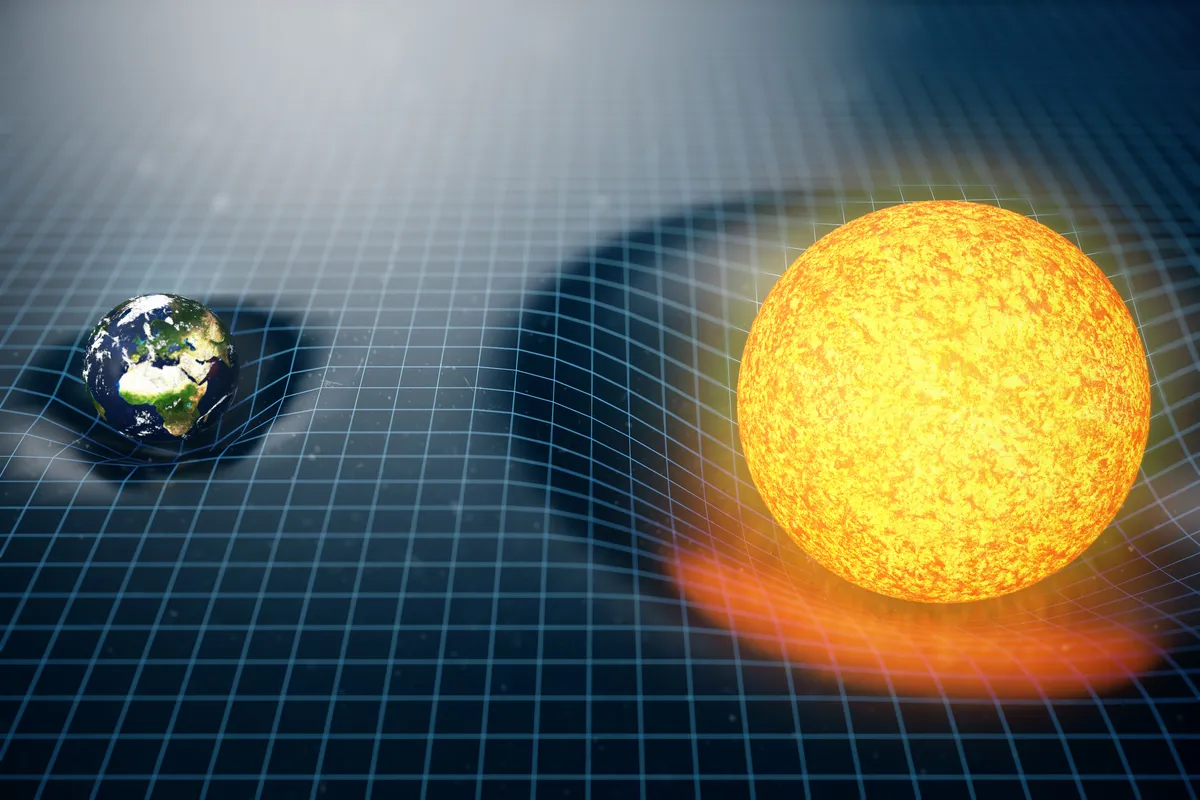
Gravity is the attraction between mass and energy, but its everyday effects come from a precise balance. At Earth’s surface, the acceleration is about 9.8 meters per second squared. A dropped object gains that speed during each second of free fall, ignoring air resistance. The Moon’s surface gravity is about one-sixth of Earth’s, so a jumper there rises higher and stays airborne longer, even though the jumper’s mass does not change.
In this thought experiment, “gravity shifted” needs a definition. Suppose the strength of the gravitational interaction changed everywhere by a small percentage while the masses, sizes, and initial motions of objects stayed the same. A 1% increase would make a person’s weight 1% higher at the same location. It would also make every orbit respond, because orbital motion is a continuing balance between forward movement and inward acceleration.
The change would not make the universe lurch as one solid object. Effects would travel through evolving gravitational systems at their own physical limits, and each system would react according to its size and timescale. A satellite may drift from its planned path within an orbit; a galaxy could take millions or billions of years to reorganize.
For a simple circular orbit, the required orbital speed rises with the square root of gravitational strength. If gravity became 1% stronger and a spacecraft kept its old tangential speed at the same radius, that starting radius would become the new apocenter because the speed is now below the circular value. The opposite side of the ellipse would be a lower pericenter. A small mismatch in a fast orbit can accumulate into a large position error.
Surface weight would shift immediately in the simplified model, but mass would not. A 70-kilogram person would still have 70 kilograms of inertia. A scale would read about 1% higher if local gravity rose by 1%, while pushing a shopping cart would require the same force to change its speed. That distinction separates weight from resistance to acceleration.
Escape speed would also rise as the square root of the change. Earth’s escape speed is about 11.2 kilometers per second at the surface, so a tiny adjustment would not fling people into space or pull the oceans into the sky. The main early effects would be altered trajectories, changed tides, and a new balance in fluids and air.
Problems On Earth
Air, water, and rock would respond differently because they are held and moved by different forces. Stronger gravity would compress the atmosphere a little more toward the ground, alter pressure with height, and reduce the height reached by a thrown object. Weaker gravity would make the atmosphere extend farther upward, though the result would depend on temperature, composition, sunlight, and escape processes.
Oceans would not simply become higher everywhere. Tides come from differences in gravitational pull across Earth, not from the average pull alone. If the same percentage changed the Sun–Earth–Moon system, the lunar and solar tidal forces would scale too. Coastlines would feel altered timing and range after the orbital system settled, while local geography would still control the actual water level.
Earth’s structure would also adjust over time. A stronger field would increase pressure inside the planet and change the load carried by mountains, ice sheets, and buildings. A weaker field would reduce those loads. Neither result predicts instant crustal failure: rock strength, heat flow, plate motion, and the size of the shift matter more than a dramatic headline.
How To Model The Shift
Define The Changed Quantity
Start by naming the quantity that changes. A global change in Newton’s gravitational constant has a different meaning from adding mass to Earth, moving the Moon, or altering only gravity near the surface. Changing Earth’s mass also changes its influence on the Moon and satellites, whereas changing the constant affects every gravitational pair in the same model. A clear assumption prevents unrelated effects from being mixed together.
Use ratios before raw numbers. If the field becomes 1.01 times as strong, surface weight becomes 1.01 times as high in the simple fixed-radius case. Circular orbital speed becomes the old speed multiplied by the square root of 1.01, roughly 1.005 times higher. That is about a 0.5% speed difference, enough to matter for precise navigation but not a reason for a person to lose contact with the ground.
Track Orbits And Tides
List each orbit’s distance, speed, and eccentricity before applying the shift. A low satellite orbit reacts on a period of minutes or hours; Earth’s path around the Sun reacts over a longer sequence of orbital cycles. The Moon’s orbit is also tied to tides, and NASA reports that tidal interaction currently moves the Moon away from Earth by about 3.78 centimeters per year. A changed field would alter the forces behind that exchange, but the new rate would require a full model.
Compare the gravitational pull at two nearby points when studying tides. The difference across Earth is small compared with the whole Earth–Moon attraction, yet it drives ocean movement. This method avoids the common mistake of using surface gravity as a stand-in for every gravitational effect.
Separate Fast And Slow Effects
Make two timelines. The first covers direct mechanical responses: a scale reading, a projectile path, a satellite’s next orbit, or a clock’s location-dependent rate in a relativistic treatment. The second covers adaptation: atmospheric redistribution, tidal friction, planetary interiors, star formation, and galaxy structure. This split keeps a one-day forecast from borrowing conclusions that need geological or cosmic time.
For a practical sketch, use a numerical orbit integrator with documented initial conditions, then vary the assumed strength by plus or minus 1%. Check conservation behavior and compare the output with a known orbit before trusting the result. A spreadsheet can show the ratio calculations; it cannot by itself capture every-body interactions or fluid dynamics.
Scenarios And Limits
Consider an anonymized satellite operator who discovers that the local gravitational field is 1% stronger. The spacecraft’s old circular speed is now too low for its old altitude. Its next path becomes elliptical, and ground controllers would need fresh orbital elements rather than a simple altitude correction. The operator’s first task would be to determine whether the shift affects the whole solar system or only the local region.
Now consider a planetary scientist comparing two long-lived Earth models. In the weaker-gravity version, atmospheric scale height grows under the same temperature assumptions, and escape becomes easier. In the stronger version, the atmosphere is more tightly bound and interior pressure rises. The scientist could compare outcomes with the same starting composition, solar input, and rotation, then report which conclusions depend on those choices.
These examples have a boundary. General relativity does not describe gravity as a knob that can be turned independently at every point while all other laws remain untouched. A physically consistent theory would need to say what field changes, how energy and momentum behave, and how the change reaches distant systems. The scenarios are useful for identifying dependencies, not for predicting a real cosmic event.
Compare The Effects
The table below compares a uniform shift in gravitational strength while holding mass, radius, and starting motion fixed. It is a first-pass guide; real outcomes would include feedback from the atmosphere, oceans, interiors, and other bodies.
| System | Stronger Gravity | Weaker Gravity | Main Caveat |
|---|---|---|---|
| Person at surface | Higher weight | Lower weight | Mass and inertia stay fixed |
| Low orbit | Old speed gives a lower perigee | Old speed gives a higher apogee | Atmospheric drag also matters |
| Atmosphere | More compact vertically | More extended vertically | Temperature and composition matter |
| Moon system | Orbit and tides readjust | Orbit and tides readjust | Angular momentum sets the path |
Common Mistakes
A frequent error is treating a percentage change in gravity as the same percentage change in every outcome. Weight scales directly with local acceleration, but circular speed and escape speed scale with a square root. Tidal effects depend on gradients, and orbital periods follow another relationship. Matching the scaling rule to the quantity prevents inflated conclusions.
Another error is assuming that Earth’s orbit, the Moon’s orbit, and a low satellite orbit change in the same instant and manner. Their distances, speeds, masses, and starting shapes differ. A calculation that works for a two-body circular orbit may fail for the three-body Sun–Earth–Moon system.
People also confuse a stronger gravitational field with faster falling in every situation. In a vacuum, objects at one location share the same free-fall acceleration regardless of mass. Air drag, shape, and buoyancy create everyday differences. A denser atmosphere could change those secondary effects after a gravity shift.
Finally, do not turn a counterfactual into a forecast. A claim about stars collapsing, galaxies flying apart, or the universe ending needs assumptions about the field, dark energy, expansion, and initial conditions. State the model, show the timescale, and mark the point where a qualitative explanation ends.
FAQ
Would people float away?
No. A small decrease would make people lighter, but Earth’s attraction would still hold them down unless the change also pushed surface speed near escape speed.
Would the Moon fall into Earth?
Not from a slight shift alone. Its orbit would change shape and speed, and tides would evolve, but an impact would require a particular change and starting trajectory.
Would time change too?
In general relativity, clocks at different gravitational potentials run at different rates. The size and pattern of any clock effect would depend on the theory behind the proposed shift.
Could life survive one percent less gravity?
Short-term survival is plausible because weight would change by about 1%, but climate, atmospheric loss, tides, and biology could respond over longer periods.
Would galaxies disappear?
No immediate disappearance follows. Stars and galaxies would adjust their motions, while the long-term result would depend on the altered field, mass distribution, expansion history, and dark-energy model.
Author's Insight
The most useful lesson is that gravity is a network of balances rather than a single everyday sensation. A 1% change looks modest on a bathroom scale, yet precise orbits can expose it quickly because their motion is finely tuned. Earth’s air, oceans, Moon, and interior would react on different clocks, so a single disaster narrative hides the real structure of the problem. Good explanations state the changed quantity, preserve the starting conditions, and separate measured physics from speculation.
Key Takeaways
A slight global change in gravity would first alter weight, trajectories, orbital speeds, tides, and the vertical distribution of air. It would not automatically destroy Earth or send the planets into chaos. The outcome depends on what changed, where it changed, how fast the change spread, and whether mass, motion, energy, and the expansion of space were held fixed. Ratios and timescales make the thought experiment useful; clear limits keep it honest.