Why Mars Turns Blue
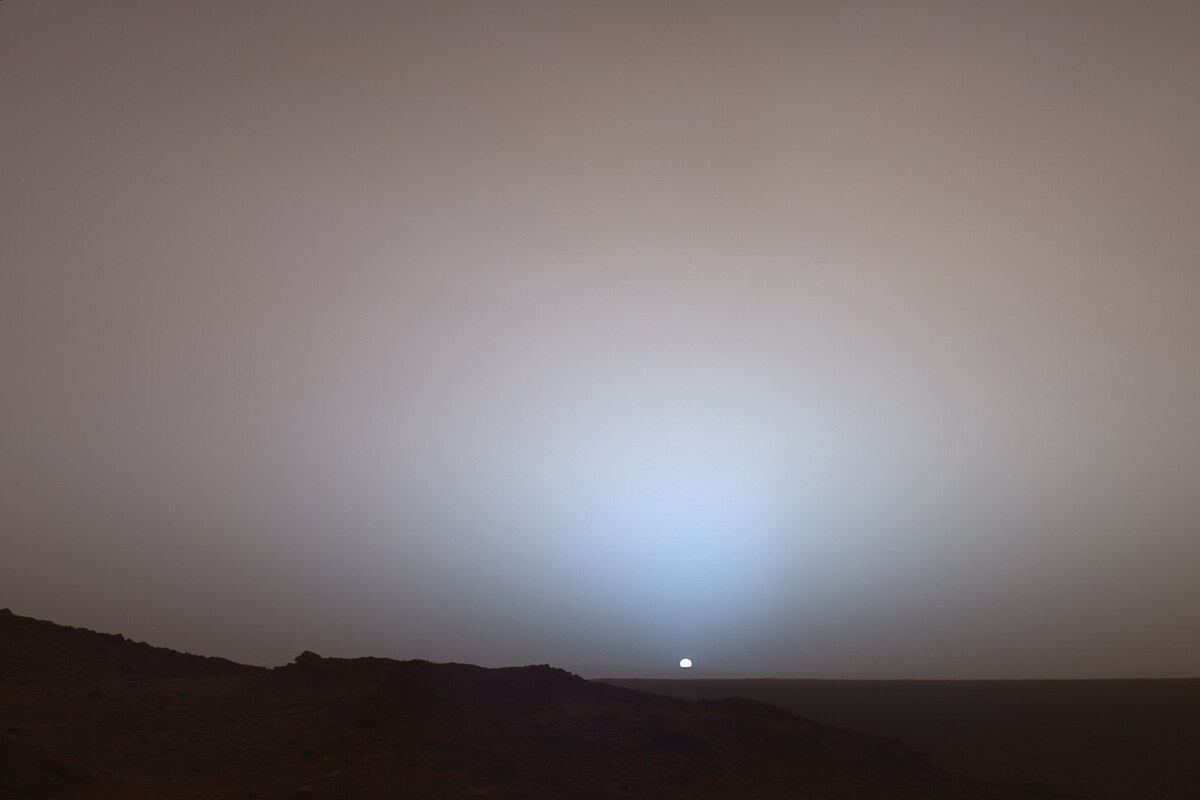
A Martian sunset can put a blue-gray glow close to the Sun while the wider sky remains tan, orange, or rusty. That reversal of the familiar Earth pattern comes from the atmosphere’s fine mineral dust, not from blue clouds or oceans. Mars has a thin carbon-dioxide atmosphere, and suspended particles give sunlight a different route through the sky than Earth’s nitrogen and oxygen molecules do.
NASA’s Curiosity rover recorded a color sunset at Gale Crater on April 15, 2015, over about seven minutes. A later Perseverance sequence came from November 9, 2021, its 257th sol. These observations are useful because the color is tied to measured light, dust, and viewing geometry rather than a painted artist’s impression. The blue patch is most visible near the solar disk, where forward scattering keeps shorter-wavelength light concentrated.
At midday, dust spreads warm tones through much of the sky, giving Mars its famous butterscotch appearance. Near the horizon, sunlight travels through a longer slanted path. The fine grains absorb some blue light and scatter the remaining blue forward, while yellow and red light spread more widely. The result is a narrow blue halo surrounded by warmer colors.
What Viewers Often Misread
The phrase “blue sunset” can suggest that the whole Martian sky turns cobalt. Rover images usually show something subtler: a blue or blue-gray region around the Sun, with tan, yellow, or orange tones elsewhere. The exact balance changes with dust concentration, particle size, solar elevation, terrain, and the camera’s exposure.
A photograph is not a direct report of what a human observer would see. Rover cameras use filters, exposure choices, image processing, and sometimes white balancing. Curiosity’s Mastcam sees color in a way similar to human vision, yet it is less sensitive to blue. A sequence can also combine frames taken seconds or minutes apart, so the Sun moves and the brightness changes during the finished animation.
Dust loading creates another source of confusion. More airborne dust can dim the Sun, soften shadows, and enlarge the warm veil across the horizon. Perseverance’s first sunset looked more muted because less dust was present than in some earlier observations. A blue color is therefore not a fixed “Mars filter”; it is a changing optical signature of a particular atmosphere at a particular place and time.
How The Colors Form
Start With Sunlight
Sunlight contains a broad mixture of visible wavelengths. Each color has a different wavelength, and particles interact with those wavelengths according to their size, composition, and the direction of the incoming beam. A clear Earth sky is dominated by molecular scattering, which sends shorter blue wavelengths in many directions. Earth’s sunset then loses much of its direct blue light along a long atmospheric path, leaving stronger reds and oranges near the horizon.
Mars shifts the balance because its airborne dust grains are much larger than individual gas molecules. The grains are made largely of iron-bearing minerals that give the surface and suspended haze its reddish appearance. Their optical behavior is not a simple version of Earth’s clear-sky scattering. The dust both absorbs light and redirects it, with the forward direction playing a large role near the Sun.
Follow The Dust
Fine dust permits blue light to travel through the atmosphere more efficiently than longer-wavelength colors in the conditions seen by rover cameras. The blue component that survives is scattered toward an observer close to the Sun’s direction. Yellow and red components scatter across a broader area, so the surrounding sky can retain a warm tint while the solar neighborhood looks cool.
The effect resembles a dusty windshield viewed toward a low Sun, though Mars has a different atmosphere and much finer airborne material. The comparison is useful only for the viewing geometry: particles become more visible when light travels toward the observer from near the source. It is not evidence that Mars has Earth-style smog or pollution.
Account For The Horizon
Sunlight near sunset crosses more atmosphere than sunlight arriving from overhead. That longer path increases the number of dust grains along the beam and makes selective absorption and scattering easier to see. The Sun also appears lower and fainter, so the nearby blue halo stands out against a darker background.
NASA images of Opportunity’s sunset reported that the Sun could be many times fainter when the atmosphere held more dust than during Pathfinder’s earlier view. The same observation described the blue tint as a forward-scattered halo. “Forward” means roughly continuing in the original direction of travel; it does not mean the blue light forms a ring evenly across the entire sky.
Read The Camera Data
Color interpretation starts with the instrument, not the thumbnail. Scientists track the filters used, exposure time, detector response, and calibration targets. Curiosity’s Mastcam and Perseverance’s Mastcam-Z can capture separate color channels, then combine them into a picture that approximates a human view or emphasizes scientific differences.
White balance changes the visual reference point. A calibrated image aims to represent the scene under a stated convention, while a raw or contrast-enhanced frame may make a faint halo look more dramatic. The distinction matters when comparing a rover panorama with a social-media crop. The images still reveal real dust behavior, but their displayed colors need context.
Two Rover Viewpoints
Imagine a student comparing Curiosity’s 2015 Gale Crater sequence with a textbook illustration of Earth’s sunset. The student labels the Martian image “wrong” because the Sun is blue. A better reading separates the observation from the explanation: the blue is localized near the Sun, the broad sky is warm, the scene was recorded through defined camera filters, and the path length was greatest near the horizon.
Now imagine a second reader comparing Perseverance’s 2021 image with an older, darker sunset. The newer frame has a weaker blue impression. That difference does not contradict the dust-scattering model. Lower dust loading, a different solar angle, exposure choices, and local atmospheric conditions can all reduce the visible contrast. The comparison becomes useful once the reader checks the mission date, camera, processing notes, and dust context.
These scenarios show why one dramatic image cannot establish a universal Martian color palette. Repeated sunsets from Viking, Pathfinder, Opportunity, Curiosity, and Perseverance show a consistent physical pattern, while their brightness and saturation vary. The pattern is the evidence; the individual frame is one sample of it.
Compare The Two Worlds
The checklist below helps readers distinguish the familiar Earth explanation from the Martian one before drawing conclusions from a photograph.
| Feature | Earth Sunset | Mars Sunset | What To Check |
|---|---|---|---|
| Main scatterers | Gas molecules plus aerosols | Fine mineral dust in thin air | Atmospheric composition |
| Near-Sun color | Often warm or pale | Often blue-gray | Particle scattering direction |
| Wider sky | Red, orange, or pink | Tan, yellow, or orange | Dust spread and path length |
| Image caution | Clouds and aerosols vary | Filters and white balance vary | Mission processing notes |
Use the comparison as a reading aid, not a rule that predicts every frame. A dust storm can make Mars darker and redder, and a low-dust atmosphere can make the halo less vivid. Earth also produces unusual sunsets when smoke, volcanic ash, or pollution changes the particle mix. The shared lesson is that sky color records the interaction of light with an atmosphere, not the planet’s surface color alone.
Common Viewing Mistakes
First, do not treat the title “blue sunset” as a claim about the entire sky. Look for the location of the cool color relative to the Sun. A broad blue field would require a different explanation from the compact forward-scattered glow seen in many rover images.
Second, do not compare an uncalibrated crop with a calibrated panorama and call the difference a climate trend. Check the camera, filters, exposure, date, and stated color treatment. A six-minute sequence can contain changing solar position and brightness, while a single still may be sharpened for public viewing.
Third, do not blame water-ice clouds without evidence. NASA’s Pathfinder explanation linked the blue near the Sun to Martian dust, not clouds of water ice. Clouds can affect a scene, but they are not needed to account for the characteristic halo.
Finally, do not infer dust concentration from saturation alone. Atmospheric opacity measurements, sky-camera readings, and repeated images give stronger evidence. A vivid display can result from processing, and a pale display can result from exposure or lower dust rather than an absent scattering effect.
FAQ
Why is the sunset blue on Mars?
Fine mineral dust scatters surviving blue light forward toward the observer near the Sun, creating a blue-gray halo against warmer surrounding sky.
Is the whole Martian sky blue at sunset?
No. The cool color is usually concentrated around the Sun, while dust can leave the wider sky tan, orange, or yellow.
Does Mars have blue clouds?
The characteristic blue sunset does not require blue clouds; NASA observations attribute the near-Sun color mainly to airborne Martian dust.
Can people see the same color as a rover?
Possibly, but the appearance depends on dust, solar angle, human vision, and camera processing, so an image is not an exact visual guarantee.
Why do Martian sunsets vary?
Dust amount, particle properties, location, season, horizon path, exposure, and color calibration change the brightness and apparent saturation.
Author's Insight
The striking reversal between Earth and Mars is a lesson in atmospheric context. The same sunlight can produce different skies because particle size, composition, and scattering direction change the route that light takes to an observer. Rover images become more informative when their colors are read with mission dates, instrument notes, and dust measurements. The blue halo is both a visual effect and a compact clue about suspended material above the surface.
Key Takeaways
Mars does not turn blue in the same broad way that Earth often turns orange at sunset. Fine airborne dust filters and redirects sunlight, keeping blue light near the low Sun while warmer colors spread through the wider sky. The effect becomes stronger along the long atmospheric path at the horizon, but dust loading and camera processing can change its intensity.
For a reliable interpretation, identify the observing mission, read the calibration notes, locate the blue region, and compare the image with atmospheric context. That method respects both the beauty of the scene and its limits: a sunset photograph is a measurement shaped by optics, not a complete weather report for Mars.