A Moldy Plate
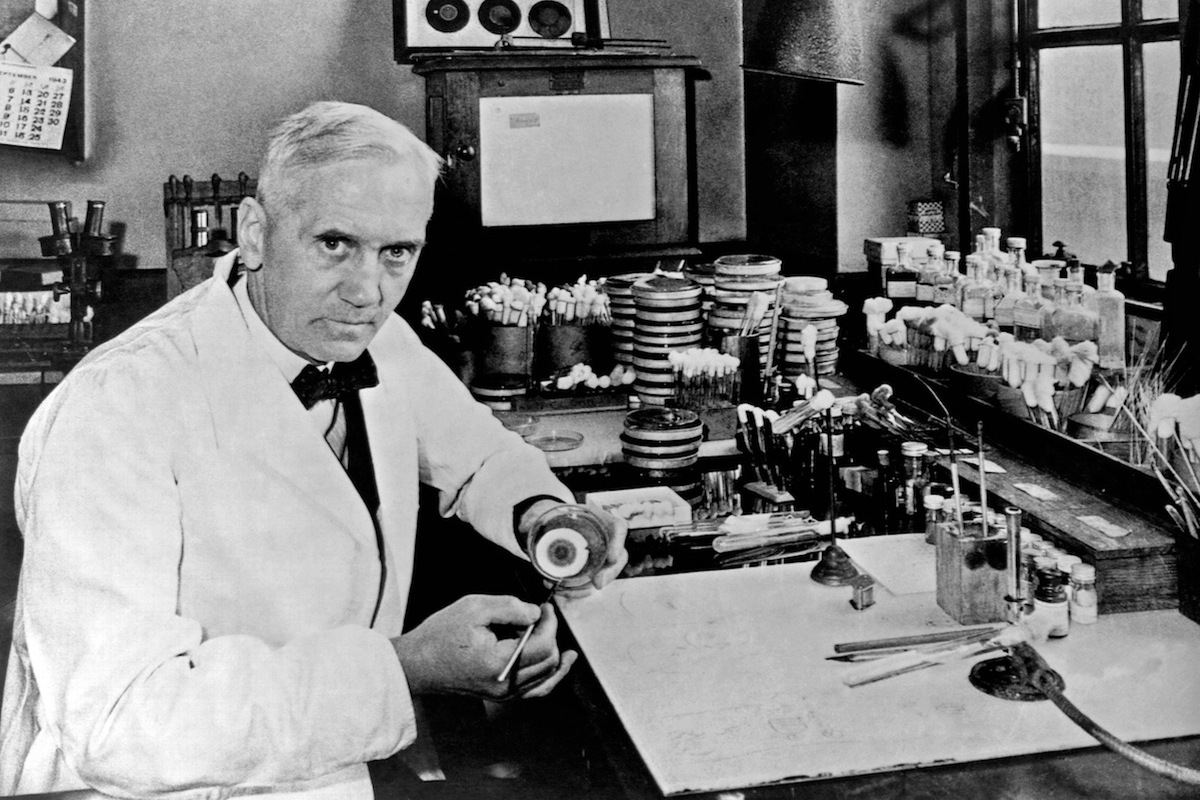
In September 1928, Alexander Fleming returned to his laboratory at St Mary's Hospital in London after time away and examined plates containing staphylococcus bacteria. One plate had been contaminated by a Penicillium mold. Around the mold sat a clear zone where the bacteria had been destroyed. Fleming did not discover a ready-made medicine on that day. He noticed a biological interaction, then tested it.
He grew the mold in broth and found that the liquid inhibited staphylococci even after dilution. The Nobel Prize presentation later described activity at dilutions of roughly 1 to 500–800. Fleming named the active substance penicillin. His report appeared in the British Journal of Experimental Pathology in 1929, yet the finding did not quickly become a drug.
That delay makes the story useful. A chance event supplied the clue, but observation, controls, chemical work, animal experiments, clinical judgment, and manufacturing turned the clue into treatment. The 1945 Nobel Prize went jointly to Fleming, Ernst Boris Chain, and Howard Florey for the discovery of penicillin and its curative effect in infectious disease.
Why The Clue Stayed Quiet
Fleming faced a difficult substance rather than a simple recipe. Penicillin was unstable, hard to purify, and produced in tiny amounts. Attempts during the 1930s to obtain it in pure form failed. Fleming explored its use in laboratory cultures and on wounds, but he lacked a chemical team to concentrate and stabilize enough material for broad medical trials.
His first observation also had a narrow setting. The mold stopped some bacteria, especially staphylococci and other susceptible cocci, but it did not inhibit every disease-causing organism. That selectivity was scientifically useful and clinically limiting. A result on an agar plate could show antibacterial action without showing the right dose, route, duration, safety profile, or effect inside a human body.
Historical retellings often compress ten years into a single lucky moment. That version hides the real problem: discovery and delivery are separate tasks. A lab may reveal a promising substance, yet its value depends on repeatable tests, reliable supply, and a treatment plan that works outside glassware.
Turning Observation Into Care
Preserve The Original Clue
Start by recording the material, organism, temperature, timing, and visible effect. Fleming's clear zone mattered because it could be compared with unaffected parts of the same culture. A modern reader can apply the same rule to any surprising result: photograph or document it, retain controls, and repeat the observation before attaching a sweeping explanation.
The mold itself also needed identification. Fleming cultivated the contaminant and linked it to the Penicillium group, later associated with Penicillium notatum in the historical account. Naming the organism did not solve production, but it converted a vague accident into an object that other investigators could study.
Separate Action From Treatment
Next, ask what the substance does and what it does not do. Fleming tested the broth against different bacteria and examined toxicity to blood cells and animals. The Nobel account records that penicillin could inhibit several bacteria linked with suppuration, pneumonia, meningitis, diphtheria, anthrax, and gas gangrene, while other species remained less sensitive.
This distinction prevents a common error: treating a broad label such as “antibiotic” as proof that every infection responds. In practice, a clinician matches a drug to the suspected organism, infection site, dose, allergies, kidney function, and local resistance patterns. The historical lesson is disciplined scope, not universal power.
Build A Working Extract
In 1939, Howard Florey and Ernst Chain at Oxford selected penicillin for renewed study. Their team developed methods to recover and concentrate the fragile substance, then tested it in infected mice. In the early experiments, treated animals survived while untreated controls died, a result that justified further work but did not by itself establish human treatment.
Small details show the scale of the obstacle. Oxford researchers used improvised containers, including bedpans, while growing mold during the early production effort. The episode is not a recipe for safe manufacture; it illustrates why purification and supply demanded collective laboratory work rather than one person's insight.
Match Production To Need
Medical use required more than proof of effect. Researchers had to grow the mold repeatedly, recover the active compound, test batches, and maintain enough potency for repeated dosing. Penicillin was rapidly excreted by the kidneys, so treatment required closely spaced or continuous dosing in the early clinical understanding.
World War II changed the funding and manufacturing context. British and American laboratories and firms worked on fermentation and scale-up because infected wounds threatened military personnel. By 1945, penicillin had moved from a bench observation to a manufactured medicine, though supply remained constrained and production methods continued to improve.
Two Paths From One Plate
Imagine a junior researcher in 1928 finding a clear ring around mold on a bacterial culture. The responsible next step is not to announce a cure. The researcher records the plate, repeats the test, checks an uncontaminated control, and asks a colleague to identify the mold. That sequence protects the observation from both dismissal and exaggeration.
Now imagine a hospital laboratory in 1940 receiving a small penicillin extract for an educational animal study. The team compares treated and untreated groups, records dose and timing, and reports adverse effects. A promising result leads to chemical refinement and carefully governed human research; it does not justify unsupervised use or a claim that every fever is bacterial.
These scenarios reflect the actual division of labor in the historical record. Fleming supplied the early clue. Florey, Chain, and their colleagues showed that the substance could act as a therapeutic agent. Production specialists then faced a separate engineering and quality problem. The final outcome belonged to a chain of evidence, not to the accident alone.
A Discovery Decision Checklist
Use this checklist to judge stories about accidental discoveries and to interpret surprising results in a lab, classroom, or workplace.
| Question | What To Check | Why It Matters | Penicillin Example |
|---|---|---|---|
| Was it repeatable? | Controls and repeated cultures | Separates a clue from noise | The clear bacterial zone was investigated |
| What is the scope? | Susceptible and resistant organisms | Stops overclaiming | Some bacteria were unaffected |
| Can it be made? | Purity, stability, and batch yield | Links discovery to use | Oxford faced low yields and instability |
| What is the risk? | Toxicity, dose, and unintended effects | Protects people from premature use | Animal tests preceded wider treatment |
Common Retelling Errors
The first error is calling Fleming the sole inventor of penicillin. He found and described the antibacterial effect, but the medicine's therapeutic development involved Florey, Chain, their colleagues, manufacturers, and many later researchers. The shared 1945 Nobel Prize reflects that chain.
The second error is saying the mold simply “killed all germs.” Penicillin has a spectrum of activity, and bacteria differ in susceptibility. The third is presenting the contaminated plate as pure luck. Contamination was accidental; recognizing the clear zone required prior knowledge of bacterial behavior and a habit of examining unexpected results.
A fourth error is treating mass production as an automatic consequence of the discovery. Penicillin's instability, low yield, purification problems, and dosing needs delayed clinical use. Finally, modern readers should not turn a historical account into medical advice. Antibiotics work against selected bacterial infections, not viral illnesses, and they should be used under professional guidance.
FAQ
What accident led to penicillin?
A Penicillium mold contaminated a staphylococcus culture in Fleming's laboratory in 1928, creating a bacteria-free zone that prompted further testing.
Did Fleming invent the finished drug?
Fleming identified penicillin's antibacterial action, while Florey, Chain, and their teams developed purification, animal testing, and therapeutic methods.
Why did penicillin take years to reach patients?
The substance was unstable and difficult to produce in quantity, so chemical refinement, repeated testing, and fermentation work were needed.
When did penicillin become widely recognized?
Its therapeutic promise emerged around 1940, wartime production accelerated access, and Fleming, Florey, and Chain received the 1945 Nobel Prize.
Does penicillin treat every infection?
No. It acts against susceptible bacteria, while viruses and resistant organisms require different medical decisions.
Author's Insight
The penicillin story is best read as a study in evidence rather than a celebration of chance. Accidents create openings, but trained attention decides which openings deserve work. The decade between Fleming's observation and Oxford's experiments shows that a discovery can remain dormant when chemistry, testing, and production are missing. Its wider lesson is practical: preserve anomalies, define their limits, and build a team capable of testing the result safely.
Key Takeaways
A contaminated culture plate supplied the starting clue for penicillin in 1928, but the medical change came through a longer sequence. Fleming identified an antibacterial substance; Florey, Chain, and their colleagues established therapeutic promise; wartime laboratories and manufacturers tackled supply. The episode rewards curiosity without romanticizing luck. For readers evaluating a surprising claim, the useful questions are simple: can the result be repeated, where does it work, what are its risks, and can it be made consistently?
The same pattern applies beyond medicine. A missed signal may deserve a pause, a control, and a second set of eyes. A useful account names the people who tested the claim, the obstacles they met, and the evidence that changed the claim from possibility into practice.