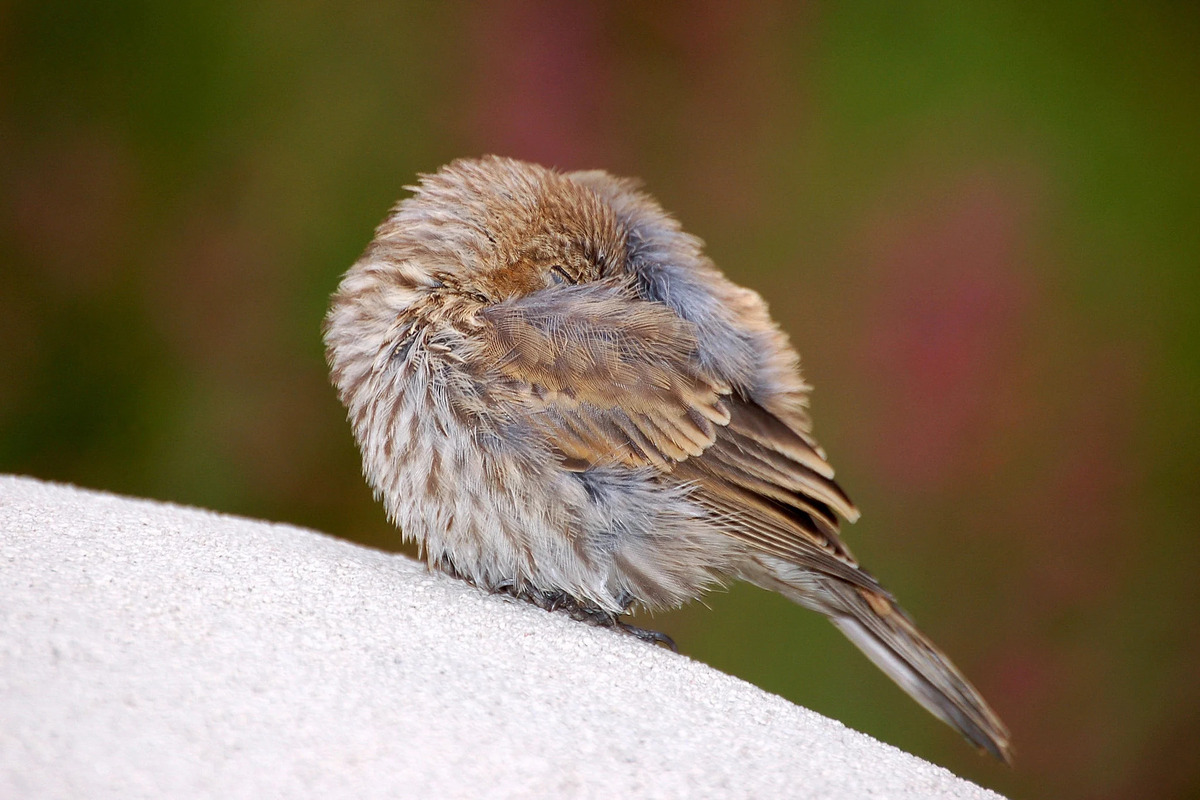
Half-Brain Sleep Explained
Sleep does not look identical across species. Dolphins, some seals and sea lions, and many birds can enter unihemispheric slow-wave sleep, a state in which one cerebral hemisphere shows sleep-like slow waves while the other remains comparatively active. The phrase half a brain is a useful shorthand, not a claim that an animal has two independent minds. The hemispheres still exchange information, and the awake side may be only partly alert.
Researchers identify this state with several clues at once. An electroencephalogram, or EEG, records slower electrical activity on one side; behavior shows reduced movement or relaxed posture; and one eye may close while the opposite eye stays open. Because visual pathways are predominantly contralateral, the open eye corresponds mainly to the opposite, more-awake hemisphere, so a bird can watch an exposed direction while the other hemisphere rests. A 1999 mallard study found that ducks at the edge of a group used this pattern more often than birds in safer middle positions.
For dolphins, the arrangement solves a basic physical problem: breathing is a deliberate action rather than an entirely automatic reflex. NOAA Fisheries describes dolphins and whales as maintaining the ability to swim, surface, and stay aware while one hemisphere sleeps. The animal can alternate sides, so both hemispheres receive rest across a longer period. This is not a perfect replacement for ordinary sleep. It is a compromise shaped by an animal’s surroundings and body.
The same behavior has appeared in birds with very different anatomy and lifestyles. A duck may keep watch for a predator, while a seabird may rest during a long glide. In each case, the evidence comes from brain recordings and behavior rather than from an open eye alone. A visible eyelid tells an observer where an animal is looking; it does not, by itself, prove that an entire hemisphere is asleep.
The Survival Problem
Ordinary sleep reduces responses to the environment, which is useful for recovery but risky in an exposed place. A sleeping bird can be attacked, swept from a perch, or separated from its flock. An aquatic mammal faces extra demands: it must control its next breath, maintain enough posture to reach the surface, and respond to nearby animals. A dolphin cannot simply become fully unresponsive underwater for hours.
These pressures create different solutions. Some animals choose a sheltered site and sleep with both hemispheres in a more familiar pattern. Others take short bouts, sleep in a group, or trade watch duty with a partner. Unihemispheric sleep keeps one channel of environmental monitoring available, but it also reduces the amount of time when both sides can recover together. Sleep need does not disappear just because the setting is dangerous.
Predation changes the balance. In controlled mallard observations, edge birds showed more one-eyed sleep than central birds, a pattern consistent with a lookout role. The awake hemisphere was opposite the open eye. Once the risk falls, a bird may close both eyes and use more symmetrical sleep. That switch shows that the behavior is flexible, not a permanent state in which a species stays half-awake every night.
Water adds another constraint for dolphins and some seals. Dolphins surface to breathe and can keep swimming slowly while resting. Eared seals can use both symmetrical and asymmetrical sleep in different contexts, while other seals may hold their breath during submerged sleep. Treating all seals as if they use the same plan hides meaningful differences in diving ability, habitat, and anatomy.
How The Strategy Works
Read Brain And Eye Signals
Start with the evidence rather than the slogan. Scientists compare EEG activity from the left and right sides, eye closure, muscle tone, posture, and breathing or movement. A sleep-like EEG pattern confined mainly to one side is stronger evidence than an animal sitting still. In ducks, the eye opposite the sleeping hemisphere commonly closes, while the open eye faces outward from the flock.
Researchers also measure what happens when conditions change. A bird placed at a safer position may use less asymmetric sleep; a bird exposed to a simulated threat may increase vigilance. Such comparisons distinguish a repeatable sleep state from ordinary drowsiness. The recordings are often made over minutes or hours, so a single photograph cannot show the complete cycle.
Match Sleep To The Habitat
Ask what the animal must keep doing while resting. A dolphin needs a controlled surfacing rhythm and enough movement to remain oriented. A bird on a water surface may need to notice a predator, whereas a bird in a protected cavity has fewer reasons to keep one eye open. A soaring seabird has a different problem again: staying aloft while using little muscular effort.
Habitat does not dictate one universal answer. Great frigatebirds have been studied sleeping during flight, but their one-sided rest is associated with gliding and circling rather than demanding maneuvers. A bird that is flapping hard, diving, or catching prey needs a fuller level of control. The practical lesson is to connect a sleep claim to a species and behavior, not to all animals that fly.
Expect Alternation, Not A Split Personality
Many animals switch the sleeping side over time. Alternation gives each hemisphere access to deeper rest while the other side takes a watch role. The timing is not a universal two-hour rule; it varies with species, setting, sleep pressure, and what researchers count as a bout. A cycle can include transitions in which the two sides are not cleanly awake and asleep.
Sleep pressure also changes the bargain. Research on birds indicates that a stronger need for rest can shift behavior toward symmetrical sleep, even though vigilance becomes less one-sided. That finding matters because it shows a cost: asymmetric sleep may protect an animal in a risky place, but it may not satisfy both sides as quickly as sleeping with the whole brain at once.
Separate Observation From Inference
Use careful wording when explaining results. An EEG can show local sleep-like activity; it does not reveal every thought or prove that the other hemisphere is fully conscious. An open eye suggests visual monitoring, but it does not measure attention. Statements about breathing, predator detection, or group coordination are interpretations supported by anatomy, behavior, and experiments taken together.
This standard also helps with popular claims. Dolphins do not literally switch off half their identity, and birds do not necessarily fly complex routes while deeply asleep. The strongest account names the measurement, the species, and the condition under which the behavior was recorded. A research paper’s date, such as the 1999 mallard work, is more useful than an unsourced viral caption.
Case Examples
Consider an anonymized flock of mallards resting beside a marsh. Birds in the center tuck their heads and close both eyes for longer periods. Birds on the outside more often keep the eye facing open water uncovered. EEG readings show stronger activity in the hemisphere opposite the closed eye. The pattern fits a surveillance trade-off, but it does not mean every edge bird is awake throughout the night or that every duck uses the behavior in the same amount.
Now consider a dolphin monitored during quiet swimming. One hemisphere shows slow-wave activity while the animal continues a steady movement pattern and surfaces for air. Later, the sides reverse. This alternating arrangement helps the dolphin keep respiratory behavior under control while granting both hemispheres sleep. It does not make the animal immune to fatigue, disturbance, illness, or the demands of captivity.
A third example comes from a great frigatebird fitted with recording equipment during a long flight. During low-effort soaring, one-sided sleep can occur while one eye remains open. The bird cannot treat every flight task as compatible with sleep: active hunting and difficult maneuvers require more alert control. Back on land, it can use longer bouts of sleep with both hemispheres involved.
Compare Sleep Modes
The table below compares patterns without ranking them. Species, age, location, and the exact study method affect the result, so these descriptions are broad biological categories.
| Sleep pattern | Typical clue | Environmental pressure | Limit |
|---|---|---|---|
| Symmetrical sleep | Both sides show similar sleep activity | Shelter and lower immediate risk | Less rapid response to danger |
| Unihemispheric sleep | One-sided slow waves and often one open eye | Breathing, motion, or lookout duty | Each side may need more time to rest |
| Short sleep bouts | Frequent brief naps | Continuous care or exposure | Rest can be fragmented |
Common Mistakes
The first mistake is treating every open eye as proof of half-brain sleep. An animal may be awake, resting, responding to light, or simply showing a species-specific eyelid position. Brain activity, behavior, and context need to line up before the label fits.
The second mistake is saying that dolphins never sleep deeply. They do sleep; the unusual feature is that slow-wave sleep can be concentrated in one hemisphere at a time. A third mistake is assuming the awake side performs every task normally. Partial alertness is not the same as full performance, and sleep can reduce coordination, attention, and response speed.
A fourth mistake is extending findings from dolphins to fish, reptiles, or all birds without checking the evidence. Similar-looking rest has arisen in different lineages, and researchers may use different definitions. Search for the species name, the recording method, and the setting. A fifth mistake is turning an adaptive behavior into a human sleep hack. Human sleep is not safely improved by trying to stay half-awake, and animal adaptations depend on anatomy humans do not share.
Finally, avoid reading a single study as a complete evolutionary story. A behavior may help with breathing, predators, group contact, or travel at the same time. The balance can change with season, position, age, hunger, and sleep pressure. Good summaries state what was measured and mark the rest as an interpretation.
FAQ
What is unihemispheric sleep?
It is a sleep state in which one brain hemisphere shows sleep-like activity while the other remains more active, often with one eye open.
Which animals use half-brain sleep?
Dolphins, some whales and eared seals, and many bird species are documented examples, though the pattern varies by species and setting.
Why do dolphins sleep this way?
The pattern helps dolphins continue controlled breathing, maintain movement, and monitor their surroundings while resting in water.
Do birds sleep with one eye open?
Some birds do, and the open eye often faces a perceived threat; an EEG is still needed to confirm one-sided sleep.
Can humans sleep with half a brain?
Humans can show small differences between hemispheres during sleep, but ordinary human sleep is not the dolphin-style state described here.
Author's Insight
Half-brain sleep shows that sleep is a biological need negotiated with the environment, not a single fixed posture. The clearest evidence combines EEG recordings with eye position, movement, breathing, and changes in risk. Dolphins and birds reached similar solutions under different pressures, an example of convergent function rather than identical anatomy. The trade-off is easy to miss: vigilance remains available, but recovery may take longer or become more fragmented.
Key Takeaways
Some animals rest one hemisphere while the other handles a limited watch role. Dolphins use this arrangement alongside controlled surfacing and swimming; birds may use it near predators, in groups, or during low-effort flight. One open eye is a clue, not a diagnosis. Species, habitat, and measurement method matter, and the behavior does not erase the need for sleep. The most accurate explanation pairs an observable brain signal with the survival problem it may help solve.